

👸🏼This Week in Spain: Welcome to Leonormania
Also Sánchez finally says "amnesty", Rubiales still in trouble and something about North Korea.
By @IanMount and @AdrianBono | November 2, 2023 | Madrid | Issue #35
🎉 Welcome to The Tapa, an English-language, weekly newsletter about all things Spain!
🥜 This Week in a Nutshell: It’s hard to believe but Princess Leonor, daughter of King Felipe VI and Queen Letizia (and heir apparent to the throne) just turned 18. And it was a huge deal. Oh, and also the cat’s out of the bag: caretaker Prime Minister Pedro Sánchez admitted that he’s going for the amnesty process in exchange for the Junts votes.
🙏 Remember that if this email gets truncated at the bottom because it’s too long, just click here to read the rest on Substack.
🙌 But wait, there’s more! The Tapa has its very own LinkedIn page to grow a new community. Please check it out and, if you’re so inclined, follow us here.
🕺If you haven’t subscribed yet, please do so by clicking on the button below.
🫶 And if you already have, please send this newsletter around to your friends and family and help us keep growing.
They grow up so fast
Princess Leonor Turned 18 and Swore the Oath, Breathing New Life into the Spanish Royal Family
Alright, so this week was kind of a big deal for the royalists in Spain.
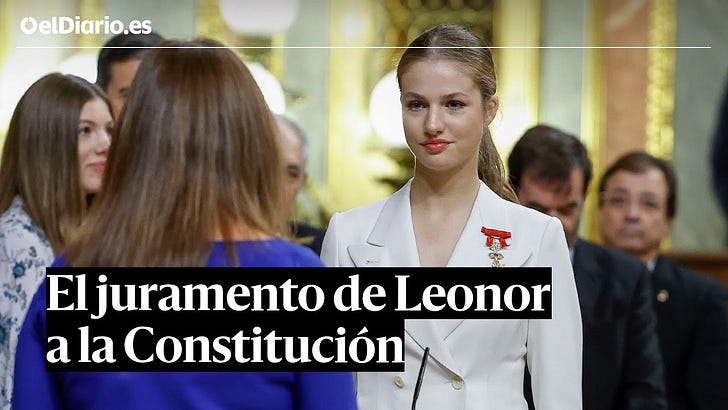
Turns out that Leonor de Borbón Ortíz, daughter of King Felipe VI and Queen Letizia, turned 18 on October 31. And as it’s customary in Spain, on the day that the Royal Family’s heir apparent comes of age, they are expected to pledge their allegiance to the Constitution in a ceremony that takes place in Parliament and the Royal Palace, and that totally ruins whatever plans they had for their birthday.
A stranger. What’s interesting is that Princess Leonor has been somewhat of a stranger for the Spanish population, as she’s always been shielded from public scrutiny by the Royal Palace and her parents.
Yet she seems to have become a sensation overnight. “Leonormania”, as the international press calls it, is very, very real. Vogue even dares ask whether she will be “the most beloved young royal since Kate Middleton”.
The event on Tuesday had all the royal-ish stuff you can imagine. From parades to speeches, meet and greets, street decorations, commemorative coins, an official luncheon and a dinner.
The oath means that, if something were to happen to the King, she is now ready to become Spain’s Queen and Head of State. “I ask the Spanish people to trust me,” she said during her speech, as she expressed her commitment to “democratic values”.
"I pledge to our democratic principles and our constitutional values, which I fully embrace," she said at the Royal Palace, where she received the Order of Carlos III. She added, "I ask you to trust in me, just as I have placed all my trust in our future." We suppose the upshot is she won’t stage a coup and try to install herself as an absolute Queen, which is nice.
The last time such a ceremony took place was back in 1986 when her dad, then-Prince Felipe, took the oath in Parliament when democracy was still in its infancy. 🐣
After the ceremony in Parliament, everyone headed over to the Royal Palace, where caretaker Prime Minister Pedro Sánchez offered a speech saying that the Princess “could count on the loyalty, respect, and affection of the Government."
Sánchez also tweeted that “with Princess Leonor’s oath, Spain today reaffirms the strength of its institutions and of its democracy, which is based on the constitutional principles of coexistence, equality, liberty and political pluralism”.
Leaders on the right were in a celebratory mood, with center-right PP leader Alberto Núñez Feijóo congratulating the Princess on her birthday and pledging on Twitter his loyalty to the Crown, a “symbol of unity, democracy and coexistence so that Spain continues writing the best years in our history”.
Far-right Vox’s leader Santiago Abascal said on X (Twitter, whatever) that he was “honored” to attend the ceremony but that people “should not forget the betrayal that a prime minister in office has handed over to the enemies of Spain”. (The amnesty. Get it?)
Leonor’s dad (aka the King) also offered some words, telling her that “she would not be alone on her journey”.
“In your family, you will find the necessary personal support, and the entire Spanish people—to whom you owe yourself—will know how to recognize your commitment and dedication with their encouragement and affection."
High-profile no-shows
While most Cabinet and parliamentary members were in attendance, there were a few notable absences.
Three Cabinet members: Irene Montero (acting Equality Minister) and Ione Belarra (acting Social Rights Minister), both from far-left Podemos, decided to skip it. Alberto Garzón, acting Consumer Affairs Minister from United Left, also did not attend. The reason for their decision to stay away is the fact that celebrating an “hereditary and unelected head of state was undemocratic”.
Also not surprising was the fact that no separatist MPs from Catalonia, the Basque Country and Galicia were present.
“In a democracy, the citizens are the ones who should choose all the institutions that represent them,” Montero said on Twitter/X. “The hereditary principle of the institution of the monarchy isn’t just outdated, it’s also incompatible with democracy. As, of course, is corruption.”
That “corruption” part was a not-so-thinly-veiled reference to Leonor’s grandfather and King Emeritus Juan Carlos I, who has been living in Dubai since 2020, after his decision to abdicate in 2014.
The former head of State, who wasn’t present at his granddaughter’s ceremony in Parliament, ended up leaving the country after a series of damaging allegations about his business dealings.
He was present at her birthday party though, which took place later that day behind closed doors at the Pardo Palace.
While the last 10 years have been tough on the Spanish Royal Family (especially after the King Emeritus’s… ahem… peccadillos) Leonor is expected to bring a breath of fresh air that allows the monarchic system to march on.
The media has put out many polls in order to learn what the plebs (us) really think about her and, as it turns out, most of the Spanish people seem to have a positive opinion of her.
Leonor scored a whooping 8.2 out of 10, while her dad got only 7.3 and her mom got a 6.4 in a poll conducted by SocioMétrica for EL ESPAÑOL. (All pretty good compared to King Emeritus Juan Carlos I, who got a 3.6).
The same poll also said that 60% of Spaniards believe that Leonor will become queen, as opposed to only 23% who think Spain will become a constitutional republic before she ascends to the throne.
🔔 A Message From Our Sponsor

Bucólico Café is a project of connection that was born as a specialty coffee shop.
We value time and understand that it represents both a cycle and an instant—chronology and nostalgia. Bucólico is a space that connects one’s soul with the purity, lightness and beauty of the countryside—while being in the city. Via a cup of coffee, a piece of cake or a song…
Located on Calle de Barbieri 4 — a few blocks from Plaza Chueca — Bucólico reassures the soul with a feeling of home.
Follow Bucólico Café on Instagram.
💬 Five things to discuss at dinner parties this week
1. Amnesty: Sánchez finally admits what everyone knew
The cat’s out of the bag. Caretaker PM Sánchez has finally admitted what pretty much everyone knew: that he has been discussing granting amnesty to self-exiled separatist Carles Puigdemont, who led the illegal Catalonian referendum of 2017, and those accused of leading the so-called “procés”.
Of course, the reason for such a controversial decision is the fact that he needs the support of separatist party Junts (led by Puigdemont) in Parliament in order to finally be elected Prime Minister again.
Sánchez made the announcement over three months after the 23J snap elections, while speaking before the PSOE’s Federal Committee on Saturday. In a speech that lasted an hour, he said that "Catalonia is ready for complete reconciliation” and that “representatives of more than 80% of Catalans support this measure”.
There’s more. “For the same reasons, in the name of Spain, in the interest of Spain, in defense of coexistence among Spaniards, I defend an amnesty in Catalonia for the events that occurred in the past decade,” he explained.
Now, we know that in politics things are never that simple. Sánchez, in fact, admitted that while an amnesty process was originally never in the books he ended up “making a virtue out of a necessity” (the necessity, of course, are the seven votes he needs from the Junts per Catalunya members of Parliament in order for him to be voted Prime Minister). But he said he feels this will “contribute to political normalization in Catalonia”.
"This is the only possible way to form a government in Spain and not give Feijóo and Abascal a second chance to form a government that would set us back decades in just a few years," he added.
He added that a coalition government of the two right-wing parties "would follow the same collision course of the past decade, widening an abyss… between Catalonia and all of Spain.”
There’s more, Pt. 2: On Tuesday night it was announced that the PSOE and separatist Catalonian party ERC (which is different from Junts) had finalized discussing the details of the amnesty law that the pro-independence party had been calling for.
The wording is not completely settled, local media reports, as there are still points to negotiate with Junts, but the part demanded by ERC, which called for a "full amnesty," has been agreed.
In short, it is very likely that either today or at some point before the weekend, the announcement will be made that Junts and PSOE have reached a deal and Sánchez has the votes to be appointed the next prime minister of Spain.
People on the right are not happy about this (as you may be able to imagine). Not one bit. In fact, they are pretty mad. So mad that on Sunday, a Vox-led protest in downtown Madrid gathered 100,000 people. Which is a lot of people.
Vox leader Santiago Abascal called Sánchez a “traitor” and said he was “the worst threat to the nation and freedom” since the return of democracy. Oh, and he said the amnesty process is so bad that it’s “worse than the attempted coup of Feb. 23, 1981”. Which, if you watch the footage from then, is quite a stretch.
2. 😘 The kiss that keeps on kissing
The end is nigh for Luis Rubiales. FIFA, the international soccer/football association, has suspended the amorous former president of Spain’s soccer federation for three years from involvement in any national or international football. Which is bad for a guy who works 100% in football.