💥 This Week in Spain: PSOE, Junts Reach Deal
Also a naughty Dane, angry airline passengers and really rich Spaniards.
By @IanMount and @AdrianBono | November 9, 2023 | Madrid | Issue #36
🎉 Welcome to The Tapa, an English-language, weekly newsletter about all things Spain!
🥜 This Week in a Nutshell: The heat around Pedro Sánchez’s amnesty plans turned up a notch as protesters (some of them violent) gathered outside the PSOE’s Madrid HQ all week, and PSOE and Junts reached a deal (based on amnesty), paving the way for Sánchez to repeat as Prime Minister.
🙏 Remember that if this email gets truncated at the bottom because it’s too long, just click here to read the rest on Substack.
🙌 But wait, there’s more! The Tapa has its very own LinkedIn page to grow a new community. Please check it out and, if you’re so inclined, follow us here.
🕺If you haven’t subscribed yet, please do so by clicking on the button below.
🫶 And if you already have, please send this newsletter around to your friends and family and help us keep growing.
💩 hits the fan
PSOE and Junts Reach Deal After a Week of Protests Against Amnesty
Disclaimer: Today’s edition of Tapa was ready to go out this morning when the world learned that the PSOE and Junts had reached a deal right before sunrise. If all goes according to the PSOE’s plan, Pedro Sánchez could be appointed prime minister as early as next week, as he will have the necessary votes in Parliament.
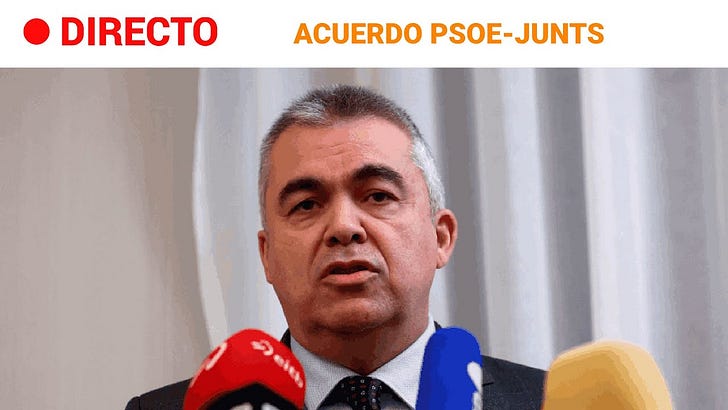
PSOE’s secretary of organization Santos Cerdán offered a live press conference in Brussels a few minutes after noon announcing the deal (see video above). “Despite our profound differences, we are ready for this new era,” he said, adding that both PSOE and Junts are “very happy” with the deal. The signed document can be reviewed here.
Cerdán added that the deal with Junts will last the entire legislature (i.e. it’s not just a deal to vote in favor of Sánchez next week). When asked about a potential independence referendum in Catalonia, he said it was a “red line” and that people know what the party’s position is. (Then again people knew what the party’s position on amnesty was before the last election…just saying.)
Catalan separatist leader Carles Puigdemont (Junts) is scheduled to offer a live press conference today at 2 p.m. from Brussels.
Right-wing parties PP (center-right) and Vox (far-right) were livid.
PP general secretary Cuca Gamarra called it “shameful and humiliating”, while Madrid’s regional president Isabel Díaz Ayuso called it “the beginning of a dictatorship in Spain, a backdoor coup”.
Vox spokesperson in the Madrid Assembly Rocío Monasterio said this agreement was “high treason to Spain and the Spanish people” and added that her party would join the people “on the streets to stop this coup”.
So where does this leave Sánchez? Right now, it looks like he has more than the necessary 176 votes in Parliament to be elected prime minister (this deal would leave him with 178).
Obligatory fly in the ointment: Sources in the basque PNV party (with five seats in Parliament) have confirmed to local media that they still haven’t reached a deal with PSOE, although they are also expected to do so soon.
But not so fast (maybe). This controversy has grown so big that even the European Commissioner for Justice in Brussels, Didier Reynders (who leans conservative), has formally asked the Spanish government for the details of the amnesty law, saying it causes “serious concerns”.
Reynders wrote, “this has become a matter of considerable importance in the public debate and the Commission has been contacted on this matter, including by a large number of citizens.”
Spain’s acting government responded that they will provide him with details as soon as a bill is introduced (an article in the PSOE-leaning El Diario said that PSOE sources didn’t think the letter was important and that stopping or pausing amnesty was outside of Reynders’ power).
Hot nights in the city: Okay, now let’s move on to the protests.
Protesters have gathered outside the PSOE headquarters (located on Calle Ferraz in Madrid’s Arguelles neighborhood) for the last few nights to express their discontent with the amnesty plans, which would eliminate any legal repercussions for Catalan separatist leaders who led the 2017 illegal independence referendum in Catalonia.
Things turned violent on Tuesday. That evening, over 7,000 people gathered outside the PSOE building to accuse Sánchez of treason and ask for his resignation.
Things went sour (like, really sour) as it became evident that members of the far-right party Vox, along with neo-fascist and Francoist supporters were in the crowd. Some were seen flying dictatorship-era flags and chanting “De cara al sol” (the former unofficial anthem of Franco-era Spain).
Projectiles were thrown at the police, and tear gas was shot back. Up to 39 people participating in the protests were injured—including 30 police officers.
According to the National Police, the serious incidents that took place outside the PSOE HQ were carried out by a mix of neo-Nazi and far-right groups whose members tend to start chaotic disturbances at the end of the protests they join. Police sources also said that the incidents that took place on Tuesday night were "perfectly orchestrated" and were far from spontaneous.
On Monday night, riot police recorded some 200 protesters on Ferraz "with their faces covered” and carrying “ultra (far-right) claims and icons”. That number doubled on Tuesday in the violent protests that ended with many garbage containers on fire and five men and one woman arrested (one of them a minor).
The PP took a while to decide how hard to come down on the violence. Party leader Alberto Nuñez Feijóo originally wrote on X that “Social unrest is the responsibility of Pedro Sánchez, but the protests must start from the respect and exemplarity that was always lacking in PSOE and its partners.” Which sorta was like we don’t like the violence but I don’t want to say that too strong.
Then on Wednesday, Madrid’s PP boss Isabel Díaz Ayuso blamed the “ultras” for disrupting what until then was a peaceful protest and expressed her support for the security and armed forces. Ayuso’s apparently rogue statement forced the center-right party to change its tune and condemn the violence more clearly. Bit of an own-goal there.
Things deescalated a bit (i.e. good news) on Wednesday evening.
Official sources in the Madrid government said some 1,500 people gathered outside the PSOE offices (a huge drop from Tuesday’s 7,000). While some clashes with the police and media were registered, the mood seemed to be different.
Francoist symbols and Nazi chants were less visible (which is nice) and most calls for violence were criticized by other protesters present (in some cases they even reported them to the police).
And finally… coining those terms: Downside of a protest with violent moments? Property destruction, arrests, embarrassing videos, and more. Upside? Comic term coinage. We’ve collected three of the best.
Piolines: When the right-leaning protestors realized that the police heroes were going to push back against their more extreme moves, they started referring to the poli as “Piolines”. Why? Piolín is the Spanish word for the Looney Toons character Tweety, who was featured on the hull of a cruise ship that housed police in the port of Barcelona before the illegal 1-O 2017 independence referendum in Catalonia. How’s it used? A right-wing protester being arrested: “Piolines! They should have thrown you in the ocean in Barcelona!”
Caye borroka. This is a double reference—and richer for being so. Kale borroka means “street fighting” in Basque, and refers to urban guerrilla actions carried out by Basque nationalist youth. So that’s one clear reference to the Madrid protest. But why Caye? That refers to Cayetano, a pejorative term used to describe posh people (like those living in Barrio Salamanca) based on the posh first name of…Cayetano. So, a rough street fight put together by the posh…ha!
“por puto defender España”: An above-mentioned Cayetano was filmed at the protest complaining all in a rush, with wet and chemically burning eyes, that the police had hit them with tear gas “for fucking defending Spain”.
🔔 A Message From Our Sponsor

Bucólico Café is a project of connection that was born as a specialty coffee shop.
We value time and understand that it represents both a cycle and an instant—chronology and nostalgia. Bucólico is a space that connects one’s soul with the purity, lightness and beauty of the countryside—while being in the city. Via a cup of coffee, a piece of cake or a song…
Located on Calle de Barbieri 4 — a few blocks from Plaza Chueca — Bucólico reassures the soul with a feeling of home.
Follow Bucólico Café on Instagram.
💬 Five things to discuss at dinner parties this week
1. 🤑 Los ricos de España wear Zara (or at least they own it)
Oops, he did it again. Yup, it’s true: Zara/Inditex founder Amancio Ortega is again Spain’s richest person, according to Forbes. And #2? His daughter Sandra.
It was a great year for Ortega (and other Inditex shareholders) as the stock has risen over 30% in 2023 after a bad 2022. Amancio’s wealth rose along with it—some 53% (😱) to €81.8bn (he also owns TONS of real estate). That makes him not only the richest Spaniard, but also 15th in the whole big wide world.
The Ortega’s are all over the list. Sandra, his oldest daughter from his first wife Rosalía Mera, clocks in at €7.1bn; his niece Dolores (daughter of his deceased older brother Antonio) with €750m; and Antonio’s widow Primitiva Renedo with €625m.
Marta Ortega, the current chair of Inditex and Amancio’s daughter (born during his marriage to Mera but to another woman, Flora Peréz, whom he would later marry and is still with) does not make it onto the list.
The rest of the list is (unsurprisingly) a who’s-who of Spanish society. There’s Mercadona boss Juan Roig (#5, €3.9bn); Real Madrid presi Florentino Pérez (#17 with €1.9bn): and Carmen Thyssen (#24, €1.4bn) whose museum you’ve probably visited.
But our favorite? You guessed it: Julio Iglesias (#49, €750m). Turns out the friend of royalty, powerhouse of romance, and all-around much-loved dude who got a video birthday greeting on his 80th from 465 celebs is also a fairly successful real estate investor. Who knew?
The 100 richest Spaniards overall are worth €196.1bn, which is a jump of 37% from 2022. Madrid and Catalonia hold 57 of the top 100, while 9 (mostly Inditex-related) are from Galicia.
♀️ Gender (im)balance. This year only 33 of the 100 were women, down from 41 last year. And the total fortune of the 100 richest women in Spain—€47bn all told—was only 24.% of that of the top 100 men—€193.8bn.
2. 💶 Madrid, ‘tax-dumping’ and a fight between Ayuso and the PSOE
Spain’s wealth taxes may be an obscure corner of the tax code, but they certainly generate a lot of heat between the PSOE socialists and the center-right PP. Things came to a head this week when the Constitutional Court ruled against the PP-run Madrid regional government’s accusation that a temporary wealth tax instituted by the national government trespassed on the region’s powers of taxation.
What? There is a wealth tax in most of Spain that is broadly paid by people with more than €700,000 in wealth (not including €300,000 for a primary residence). But because the power to levy the wealth tax is ceded to the autonomous communities, each one can decide its rates and cutoffs.
Madrid’s regional government did just that: It eliminated the wealth tax years ago (2008) because it’s home to most of Spain’s large fortunes and would like to attract more. And what better way to attract rich people than to not charge them a wealth tax?!