

🗣️ This Week in Spain: How do you say 'Drama' in Catalan?
Also sad footballers, a battle elephant and maybe cancel your move to Andorra?
By @IanMount and @AdrianBono | September 21, 2023 | Madrid | Issue #29
🎉 Welcome to The Tapa, an English-language, weekly newsletter about all things Spain!
🥜 This Week in a Nutshell: Happy first day of autumn! All hell broke loose in Parliament on Tuesday after MPs started using co-official languages on the floor, irritating the right-wing parties and causing the biggest language confusion and work disruption since the Tower of Babel.
👍 Also, last week we had a record number of likes (again!) so can we try it again this week please? It really helps us grow.
🙏 Remember that if this email gets truncated at the bottom because it’s too long, just click here to read the rest on Substack.
🙌 But wait, there’s more! The Tapa has its very own LinkedIn page to grow a new community. Please check it out and, if you’re so inclined, follow us here.
🕺If you haven’t subscribed yet, please do so by clicking on the button below.
🫶 And if you already have, please send this newsletter around to your friends and family and help us keep growing.
You say ‘tomato’, I say ‘Go f*** yourself’
Madrid Goes Full Babel
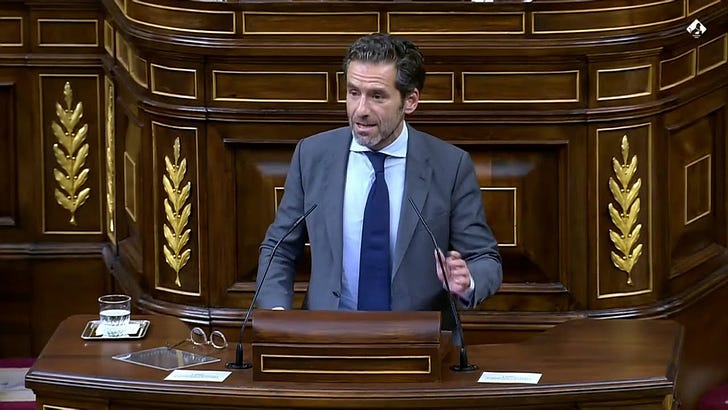
Borja Sémper, a Basque Country-born bigwig in Spain’s center-right PP, spoke a few sentences in Basque (or Euskera, as the language is known in Basque) from the speaker’s dais in parliament on Tuesday.
Not to celebrate the new approval of the use of Spain’s “co-official” languages (Euskera, Catalan and Gallego) but in order to criticize MPs for using these regional languages instead of the Castilian Spanish that all Spaniards know and share.
Other MPs laughed, clapped, or booed. The parliament’s speaker repeatedly asked for silence. And the members of far-right Vox, theoretically allies of the PP, walked out—for the second time in the day.
So, yeah, languages are a big deal in Spain. Or a tense subject. Or the third rail. What you speak is identity. Who you are—and who you aren’t. You get the idea.
This all, of course, comes back to politics. As we wrote last week, the approval of the use of co-official languages in parliament was a condition set by the Catalan pro-independence parties ERC and Junts in exchange for supporting the election of former Balearic Islands president Francina Armengol (of the PSOE socialists) as parliament speaker last month.
But now it’s happened and it (predictably) was a mess! Vox walked out the first time in protest of the use of the co-official languages, after PSOE deputy José Ramón Besteiro became the first to use one when he began speaking in Gallego.
One by one, the Vox MPs left the earpieces (pinganillos) they’d been given to listen to the translation of the co-official languages on the seat of caretaker Prime Minister Pedro Sánchez (see video above).
Fun fact: Parliament is expected to spend up to €280,000 on translation through the end of the year, including tech, interpreters, and so on.
Besteiro was the first but far from the last. Marta Lois of Sumar, the PSOE’s far-left partner party, also spoke in Gallego, and suggested that people all over Spain study the co-official languages (not a bad idea, tbh). Maite Aizpurua, spokesperson of the Basque-separatist EH Bildu, spoke in Euskera, as did Joseba Andoni Agirretxea, of the PNV Basque nationalists.
But it was Gabriel Rufián of the left-leaning ERC Catalan separatists whose speech in Catalan attracted the most attention. Not because of what he said (Castilian isn’t persecuted in Catalonia, Catalán speakers aren’t all separatists, etc etc), but for how he said it.
While Rufián may be a Catalan nationalist, he is also the Catalonia-born son of Andalusians whose first language is Castilian, and it seems like his command of the Catalán language is…not great. “In all seriousness, I am Catalán and I find it hard to understand him,” said one observer, while another mused, “Rufián speaks Catañol” and another said “Rufián speaks Catalán as well as [Sumar boss] Yolanda Díaz does English” (ouch!).
Most cutting was PP deputy Cayetana Álvarez de Toledo (aka the Spanish right’s Cruella de Vil) who wrote on X (né Twitter), “Unexpected technical difficulty: Rufián has to be translated to Catalán”.
But while the parliamentary floor in Madrid was all fun and games (and talk about how allowing in the co-official languages was either a long overdue recognition of Spain’s cultural diversity or a divisive scam that would break the country into tiny pieces), Prime Minister Pedro Sánchez’s bid to bring Spain’s multiple-personality identity crisis to Europe’s main stage didn’t go quite as well.
You see, one of his other promises to get the votes he needs to repeat as PM was to push Catalán, Euskera and Gallego as official EU languages—meaning they could be used in the European Parliament and EU documents would be translated into them.
Let’s just say that there was some reticence among the Europeans. As we also noted last week, several countries pushed back on adding them to the 24 already there, (because, expensive) and because it could open the door to even more languages (even more expensive). Last year, the European Commission spent €355 million on translations, and they maybe aren’t super-excited about upping that.
Spain holds the Presidency of the Council of the European Union right now, offering Sánchez a perfect opportunity to bring up the issues. But the other countries on the council nixed Spain’s desperate push for a swift addition of the three languages, even after Spain said please please we’ll even pay for the cost and you can do it slowly and and and….
“No one can expect a decision to be taken in Brussels in one morning on a proposal whose paper version has just reached us that same day," the Irish representative said, according to El Español, while another diplomat complained “They’ve brought a national problem to the European level.”
Spain’s foreign minister José Manuel Albares then apparently suggested the EU just push Catalán through for now, which sorta makes it obvious whose votes Sánchez needs to repeat as PM (and seems to have royally ticked off Basque leaders).
EU diplomats threw up their hands at the end, saying that they could return to the subject in three months. "It is not just about the issue of Catalan: we are changing the logic of the EU linguistic regime and that can have an impact on dozens of other regional languages,” one said, according to El Español. “This is opening Pandora's box."
In other words: No go, Pedro. (Or as Rufián might say, “De cap manera, Pere”.)
The question now is how (if at all) this Euro setback will affect PM Pedro Sánchez’s chance at another term. Carles Puigdemont, the boss of Catalan separatist party Junts now living in the Brussels suburbs, apparently thinks enough has been done, giving the PSOE room for optimism. So maybe “Yes go, Pedro”? We’ll see next month.
Last minute addition: on Thursday morning, Parliament voted in favor of approving the use of co-official languages (PP and Vox voted against it).
🔔 A Message From Our Sponsor
Secret Kingdoms is your English bookstore in Madrid. It specializes in Spanish history and literature, contemporary and classic novels, books for children and young adults of all ages, history and historical fiction, thrillers, science fiction, fantasy, poetry, biographies and much more.
Located on Calle de Moratín 7 — a few blocks away from the Prado Museum — and with over 20,000 new and used books, Secret Kingdoms has something for everyone.
Find out more at www.thesecretkingdoms.com
💬 Five things to discuss at dinner parties this week
1. 😞 Spain’s unhappy footballers
Most of us would be totally thrilled to be called up to Spain’s international women’s soccer squad—most of us, that is, except the actual members of Spain’s international women’s soccer squad.
It’s been one month since they won the 2023 Women’s World Cup and less than that since their hated coach Jorge Vilda and non-consensual kissing football association boss Luis Rubiales were fired and resigned (respectively).
Now the team is back in action with a game Friday against Sweden as it tries to advance in the UEFA Women’s Nations League.
You might think that they’d be happy to play after getting rid of the widely loathed Rubiales and Vilda. You’d also be wrong.
When new women’s coach Montsé Tomé published the list of tapped footballers, there was immediate and fierce pushback from the footballers and their friends. Why?
Of the 23 players Tomé called up, 15 had been on the championship World Cup team. More importantly, 20 had signed a petition slamming the Spanish RFEF soccer federation—expressing their “enormous discontent” with the federation’s treatment of women and demanding five specific, and extensive, changes before they returned to the national team.
The players who signed that petition then released another after Tomé released her list, reiterating their “firm desire not to be called up.”—i.e. they planned to strike against the national team until the changes were made.
That’s when things got ugly. Really very unpleasant, actually. It came out that players who did not show up when named to the national team could face a fine of up to €30,000 and other penalties. Also, Jenni Hermoso, the player on the receiving end of Rubiales’ non-consensual kiss, was not called up—leaving people to wonder if she was being punished.
Ana Crnogorcevic, a Swiss footballer who plays in Spain, lashed out at the call-up on X (né Twitter): “This is insane… how can you threaten your own player like this…😳 call them to the national team, when they said they want clear changes before they come back! this is soooo disrespectful… clearly they don’t care… and they don’t allow them to make their own decision.”
