

🐻 This Week in Spain: Groundhog Day 2
Also an arrested mafioso, Grand Prix is back, and scary watermelons.
By @IanMount and @AdrianBono | July 27, 2023 | Madrid | Issue #25
🎉 Welcome to The Tapa, an English-language, weekly newsletter about all things Spain!
🥜 This Week in a Nutshell: We’re done with elections… right? Spain finally went to the polls in the middle of summer and the people spoke loud and clear: None of the above. The question is now whether Pedro Sánchez can form a new coalition government or we head back to the polls… again.
🙏 Remember that if this email gets truncated at the bottom because it’s too long, just click here to read the rest on Substack.
🙌 But wait, there’s more! The Tapa now has its very own LinkedIn page to grow a new community. Please check it out and, if you’re so inclined, follow us here.
🕺If you haven’t subscribed yet, please do so by clicking on the button below.
🫶 And if you already have, please send this newsletter around to your friends and family and help us keep growing.
Voting on Christmas Eve, anyone?
Election Aftermath: Winners, Losers and What’s Next
What an election!
When we thought everything was said and done, here comes Prime Minister Pedro Sánchez once again to prove that he has more lives than a cat.
Yes, in theory the center-right Partido Popular (PP) won the election as it was the most voted party. But they ended up far from the 176 seats needed for an absolute majority, a number they couldn’t even reach by forming a coalition government with far-right Vox.
Sánchez’s center-left PSOE, however, may be able to reach that number—but in a cruel twist of fate they will need the support of the Catalan separatist party Junts per Catalunya run by Carles Puigdemont, who led the 2017 attempt to break away from Spain and now lives in self-imposed exile in the Brussels suburb of Waterloo (where Napoleon was defeated). So there’s certainly something symbolic there?
Will the Prime Minister find a way to strike a deal with them? The clock is ticking and if no deal is reached soon (more below about how “soon” is calculated), we may be forced to head to the pools again around Christmas. “Summer and Christmas?” you ask. Yes, hijo mio, we’re only doing vacation elections from now on.
First, let’s a brief look at the winners and losers of this election.
Winners
Pedro Sanchez, the PSOE and Yolanda Díaz’s Sumar (kind of)
The left mostly held its ground. Pollsters and pundits the country over counted them out for dead, but the PSOE and Sumar won 153 seats, just five less than the 158 the PSOE had with Podemos in 2019. Not the catastrophic flop expected. They managed to instill fear in many voters about what Vox would do—Franco will return!—and Sánchez didn’t attack Sumar, which kept things all smiley between them.
In the end, many of the government’s mistakes and controversies (the “only yes means yes” law, the pardon of jailed Catalan leaders, etc.) didn’t really translate into a massive migration of votes from the left to the right.
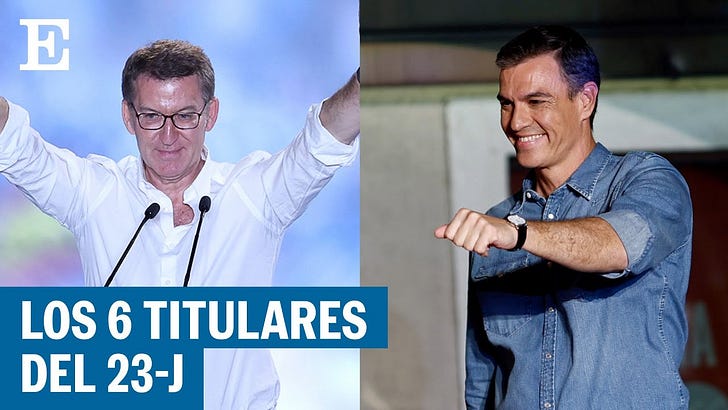
During his “victory” speech on Sunday night (see video above), Prime Minister Sánchez said Spain had spoken “loud and clear” and that the “regression bloc (PP + Vox), which proposed a total elimination of all of the progress we’ve made in these last four years, has failed”.
Losers
Alberto Núñez Feijóo (Partido Popular)
The leader of the center-right PP was predicted to be the biggest vote-getter of the elections. And he was. But while most pundits ventured that he would be able to form a government with far-right Vox, the two combined fell short of the magic number of 176 seats (PP’s 136 + Vox’s 33 = 169).
And because the PP was open to forming a government with toxic (for most) Vox—and did so in several comunidades—they now officially have cooties and no one will consider helping them get over the line. So he won… but he really lost. And now people are asking if Madrid regional president Isabel Díaz Ayuso will replace Feijóo, but that’s for later.
Santiago Abascal (Vox)
Vox was the biggest loser of the night. The far-right party went from 3.6 million votes and 52 seats in parliament in 2019 to 3 million votes and 33 seats in 2023. So… really bad.
Santiago Abascal bears huge personal responsibility for the loss. Instead of laying low during the campaign, he played “How incendiary can I be?” by saying things like if there were a PP+Vox government in the Moncloa Palace the tensions with Catalonia’s separatist-led Generalitat would be “worse” than in 2017 (when they were f-ing awful). Which basically was a recipe to make every Catalan who was thinking of voting PP change his mind and inspire every on-the-fence voter (especially in Catalonia) who didn’t want to relive 2017 to come out to vote anti-PP/Vox.
In a last minute attempt to find a way to form a coalition government, Vox is now saying they would agree to a pact that includes “a few good socialists”. In other words, they are wondering whether PP can find a way to turn some PSOE seats and hopefully reach the 176 mark. This is, of course, practically impossible.
Vox remain the third largest political party in Spain, but their results were so bad that they can no longer put forward ill-considered no-confidence votes (like they did in March). You need 35. Vox may have reached its electoral peak.
What happens now?
First, ignore the noise. Feijóo has said he is ready to explore coalitions that allow him to hit the 176 mark, like by joining with the regional Basque nationalist party PNV. But the Basque party was quick to say they would never ever be part of a coalition government with Vox, and even criticized Feijóo of “crossing a red line” with his regional deals with the far right. Cooties, like we said. No way.
Feijóo also insisted that, since his party got most of the votes, he should be allowed to govern because that makes sense somehow. Not gonna happen.
The next step? For now, Sánchez will go on vacation, and fly to EU events that allow him to look “presidential”. While he is tanning and glad-handing, his team—most likely led by chief of staff Félix Bolaños—will be feeling out what he needs to offer to buy the support of the bazillion (okay, five) parties he needs to repeat as PM.
The new Parliament will be formed on August 17, and its officers will be elected. That’s when the King (you know, Felipe VI, aka Mr. Snazzy) will meet with the various parties and, when one says convincingly that it has the votes to form a government, will propose that candidate.
Then, the clock begins to tick. The proposed candidate will have two votes in parliament. In the first, he (or she, though probably he this time) needs a ‘yes’ vote from a majority of seats (i.e. 176) and in the second, just a majority of those who vote (abstentions play a part).
If the candidate fails, parliament has 60 days to elect a prime minister, after which parliament is dissolved and new elections would happen some seven weeks later. Fun!
The negotiations to form a government will (almost inevitably) be between Sánchez and the Catalan separatist parties. The question—will he offer enough to win them offer?
ERC may be happy with regional investment and steps toward some sort of ill-defined vote on changes in the relationship between the region and the central government.
But the more radical Junts, led by the self-exiled former regional boss Carles Puigdemont, insists that it demands full amnesty for those involved in the unconstitutional independence referendum the regional government put on in 2017 (the prosecution for which Puigdemont moved to Waterloo to avoid)—and a real referendum on the region breaking off from Spain. Negotiations will be tricky. Junts as a political party is hard to define as they are more of a curious amalgam of pro-independence activists than anything else. Defining them as leaning right or left would be a mistake (their fiscal policies tend to lean right) and achieving independence from Spain is their only true north.
How rigid their demands are and whether Sánchez thinks new elections will help or hurt him will determine whether we head back to the polls.
For now, enjoy your vacation!
🔔 A Message From Our Sponsor
Secret Kingdoms is your English bookstore in Madrid. It specializes in Spanish history and literature, contemporary and classic novels, books for children and young adults of all ages, history and historical fiction, thrillers, science fiction, fantasy, poetry, biographies and much more.
Located on Calle de Moratín 7 — a few blocks away from the Prado Museum — and with over 20,000 new and used books, Secret Kingdoms has something for everyone.
Find out more at www.thesecretkingdoms.com
💬 Five things to discuss at dinner parties this week
1. 🚨 An Italian mobster arrested on…Gran Via?
Madrid’s Gran Via was even livelier than normal on Monday—and no, it was not because Rosalia in disguise held an impromptu concert in front of Primark (though we’d like that). Instead, a gaggle of undercover cops arrested an Italian gangster while he was walking his dog, with a big fistfight and all!
The story began in a hotel in the Sardinian city of Cagliari, when the gangster and his girlfriend were supposed to deliver 3 kg. of cocaine to some buyers, but instead shot them up and walked away with the cocaine and the money to boot.
Italy’s Polizia di Stato busted the group of criminals behind this and other similar crimes, arresting 25 people. But they realized they’d missed two—the narco and his girlfriend.
They learned that the two might be in Spain. Through ENFAST (European Network of Fugitive Active Search Teams), the Italians brought in the Spanish police, and the chase was on.
The Spanish chase was difficult because the two were multilingual and had a pile of false ID documents of various nationalities. After investigating leads in Alicante, Barcelona and Malaga, police got a break in mid-July when they located the pair in a downtown Madrid hotel. Both were using Spanish ID documents.
Plainclothes police waited outside the hotel until, around noon, the two emerged—with their dogs.
5 policemen went to arrest the narco, who tried to flee… and then fought back. Two agents suffered minor injuries and the narco kept kicking even after being bundled into the police cruiser.
The agents seized €3,800, a Dominican passport and a Spanish driving license forged with the guy’s photo, as well as a Spanish ID document, also forged, with the photo of his partner. He was arrested on the charges brought up by Italy, and the woman was arrested for document forgery.
“Gran Via mobster arrest” is a good headline, but not quite as good as another Spanish takedown, when in December 2021 the police found an Italian gangster who’d be on the lam for 20 years after someone looking a lot like him appeared in a Google Maps photo outside of a vegetable shop he owned in Galapagar (home to Pablo Iglesias and Irene Montero too!). “How did you find me?” he asked after his arrest. “I haven’t even called my family in 10 years.”
