

🔥 Spain is Burning
Plus: Zapatero on live TV, and a really old turtle.
Madrid | Issue #157 | The Bubble is Spain's #1 English-language newsletter. We offer paid and free subscriptions (which you can customize). For sponsorships, click here.
🚨 Like all good Spaniards, this newsletter — our Thursday news and politics one — will take a break in August. (Our Friday events guide will continue publishing!) See you in September…and enjoy 😎!
Scorched earth politics
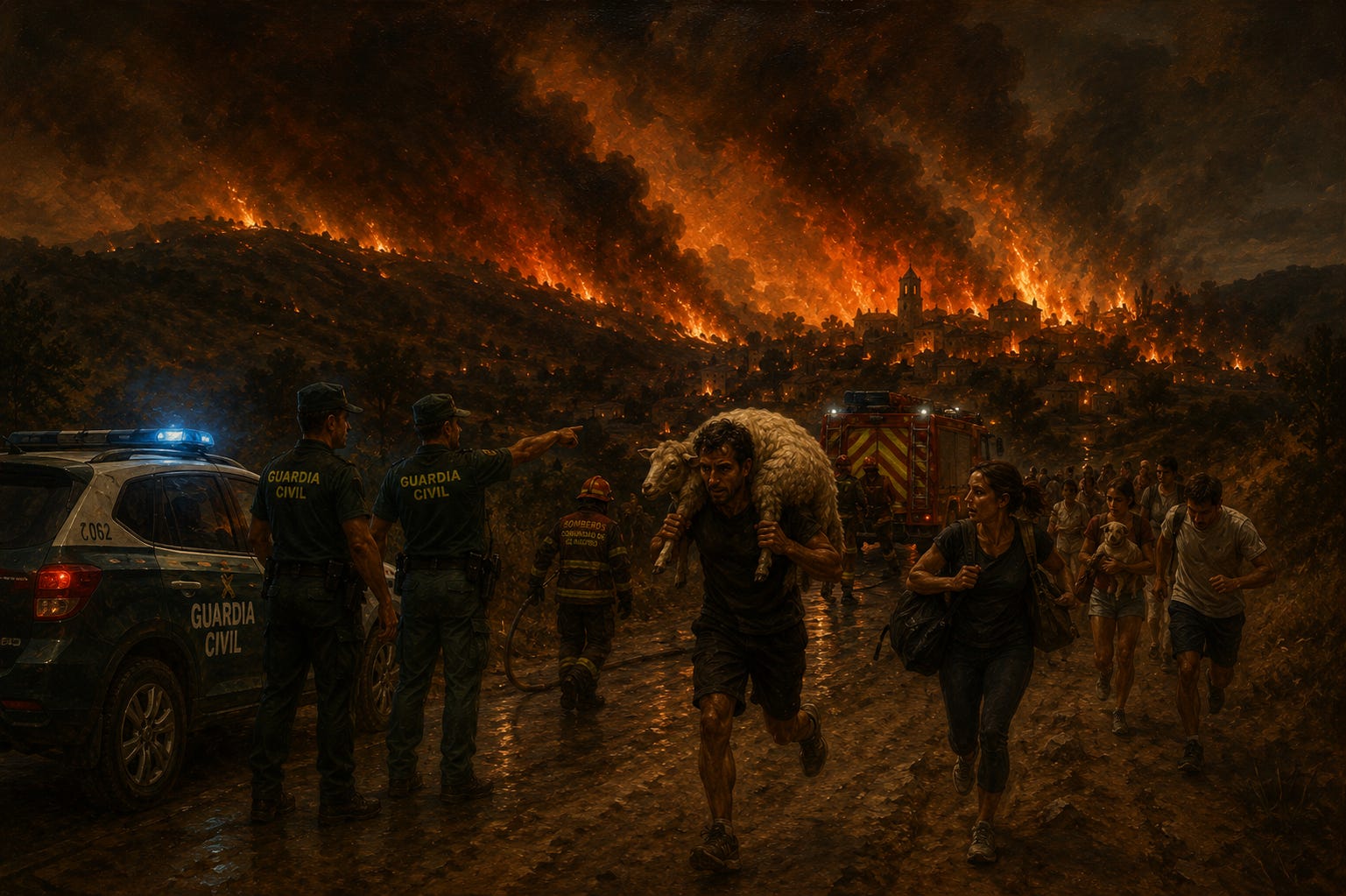
🔥 Spain's worst wildfire on record appears to be under control at last. Don't get used to saying that.
Bad times. For nearly a week, large parts of central Spain looked like something out of a movie apocalypse, with hillsides burned, villages and towns evacuated, highways closed, and smoke from the flames visible from Madrid.
The scene was an inferno. At its peak, the government declared a Level 3 national emergency—the first time Spain has ever done so for wildfires—and tens of thousands of people were forced to flee their homes.
The good news is that the situation seems to be finally improving. The massive fire affecting Madrid and neighboring Ávila had been technically stabilized as of last night, authorities said, allowing thousands of residents to begin returning home.
But “stabilized” doesn’t mean over. Firefighters remain on alert, several areas are still evacuated, and officials warn that another heat wave could easily reignite hotspots in the coming days. (Yesterday Prime Minister Pedro Sánchez said things were “favorable”, although he asked people to be “cautious”.)
The big one. The fire that devastated Madrid and Ávila has already gone down as the largest wildfire in modern Spanish history, burning more than 50,000 hectares.
One culprit. Investigators believe the disaster in Ávila began with a spark from an excavator carrying out illegal work to open a road near Burgohondo (Ávila) during a period when heavy machinery was banned due to the extreme fire risk.
The eight-ton machine struck rock with a hydraulic hammer, the Guardia Civil said, creating the spark that ignited dry vegetation. The fire then exploded across forests already primed by weeks of scorching temperatures, low humidity, and strong winds.
A heartbreaking tragedy. The human cost has been huge. Around 63,000 people were evacuated at the height of the crisis, making it one of Spain’s largest peacetime evacuations in recent memory.
Home again. Roughly 24,000 have now been allowed to return home, while another 10,000 people in Madrid remain displaced or confined. Authorities say at least 100 primary residences have been destroyed, with the damage to second homes still being assessed.
Happy news. Despite the scale of the disaster, no deaths have been reported, although several firefighters and emergency personnel suffered injuries during the operation.
The fires stretched far beyond Madrid. According to the European Forest Fire Information System (EFFIS), more than 206,000 hectares have burned across Spain this year—well above the average—and the country has recorded 376 fires, more than double the norm.
Spain didn’t fight the fires alone. Through the European Union’s Civil Protection Mechanism, Greece, Italy, and Türkiye sent firefighting aircraft, while Portugal deployed more than 130 firefighters and dozens of emergency vehicles to help contain the flames.
Enter politics. The disaster briefly produced an unusual display of cooperation. PM Sánchez praised the “institutional loyalty” shown between different levels of government and renewed his call for a national pact to prepare Spain for a future of more frequent climate disasters.
Madrid presi Isabel Díaz Ayuso (of the center-right PP) announced 58 recovery measures, including psychological support, hotel accommodation for displaced residents, aid for damaged homes, veterinary care, and assistance for elderly and dependent people.
But, no. The PP, however, rejected Sánchez’s proposal for a pact, accusing the government of weakening Spain’s firefighting capabilities, while simultaneously urging Brussels to develop a stronger EU-wide wildfire prevention strategy.
Scientists have warned for years that longer heat waves, prolonged droughts, and abandoned rural land are creating the perfect conditions for larger, faster-moving wildfires. This year’s figures already suggest that warning is already reality.
More news below. 👇👇
🎙️ Episode 4 of The Bubble Podcast is out!
On our latest episode, we discuss what it really means to belong in Spain today and explore one of the country's biggest identity debates—from immigration and Spain's record-breaking migrant regularization to the controversial Ley de Nietos—alongside Sweden's ambassador to Spain and writer Elizabeth Duval.
Subscribe and listen on Spotify, Apple Podcasts, and YouTube!
💬 Five things to discuss at dinner parties
1. 🤦 Zapatero gave his first interview and cleared up nothing
Every political junkie in Spain was glued to TVE last Thursday. Former PM José Luis Rodríguez Zapatero was there, on Mañaneros, giving his first interview since an Audiencia Nacional (National Court) investigating judge charged him with leading a network of illicit influence peddling. Bring out the 🍿, because it was a doozie.
The situation. Judge Calama of the Audiencia Nacional has Zapatero under investigation for allegedly running an influence-peddling scheme around the government bailout of airline Plus Ultra, plus money laundering, tax fraud, smuggling, and organized crime.
The fly in the ointment. Two days before the interview, his associate Julio Martínez — the administrator of consulting firm Análisis Relevante, the alleged hub of the operation — told the judge that Zapatero was “the one who set the pace,” i.e., el capo.
What Zapatero said. He mostly repeated what he’d already told the court in June. He again said he spoke about Plus Ultra to nobody in the government or the body that bailed it out (SEPI). He was just a consultant who created reports, he said. And that Dubai offshore company supposedly set up to hide his income? “An absolute invention”. Finally, did he use his daughters as fronts? Good god no, that would be “incredible.”
Maybe I talked to someone. He did admit calling a Santander executive to arrange a meeting for Plus Ultra’s directors — but insists that’s just “facilitating a contact,” not peddling influence. Yeahhhh….
And what he didn’t. Zapatero didn’t address that testimony of his buddy Julito Martínez, who’d told the judge that Zapatero ran the show. “I am not going to get into the defense strategy of any defendant,” he said. hmmm…
Where those jewels came from. When asked about the 80 or so pieces of jewelry found in his office safe — valued at €1.32m ‼️— he said they were “a courtesy gift from many years ago.” From who? “I’m not going to say the country.” Why undeclared to the taxman? “There was no patrimonial intent“ (what?). Did he know they were worth over a million? “We couldn’t even imagine that,” he said (his people previously estimated them at €30-50,000). He also said the jewelry gave him “a severe allergic reaction,” which we don’t understand…but find intriguing.
Rules are for fools. And on the good governance code he signed as PM, which explicitly prohibits gifts of this value? “Interpretable.”
And this was on a friendly channel. El Español noted that after 20 minutes of hard questions, Mañaneros host Javier Ruiz declared Plus Ultra, the daughters, and the jewels all “done” — when none were resolved — and spent the rest letting Zapatero play the victim over his leaked agendas and invaded privacy. Ruiz ended with: “President, how are you doing?“ Awww…
The reviews? Not positive.
Friends. The PSOE closed ranks behind their colleague publicly but privately felt let down: “We didn’t really understand the utility of the interview,” one source told El Mundo. Later, PM Sánchez got colder: “I’m not his spokesman,” he replied when asked this week about the case.
Enemies. The opposition PP called his explanations “a joke,” while Madrid mayor Almeida described the interview as a “bath and massage session.” 🤣 Ouch.
What’s next? Zapatero still owes an explanation to Judge Calama about the jewels — he dodged those questions at his June testimony too.
2. 👉 Catalonia could take a hard (separatist) right turn
You thought Spain’s national government had drama with the far right? Take a look at Catalonia. There, a new poll shows that if elections were held now, far right parties could take up almost a third of seats in the regional parliament — with a new separatist party being the breakout star.
The latest poll shows a big win for Aliança Catalana. The hard right separatist party led by Silvia Orriols (anti-immigrant, anti-Spain, pro-independence) would win 25-28 seats in the 135-seat parliament — up from a mere two seats now — and become the second-largest party, according to a poll taken by GESOP for El Periódico, a center-left newspaper.
And they’re not the only tighty-far-righties on the ballot. Add in the 11-13 seats expected for the hard-right Vox (anti-immigrant, pro-Spain, pro-bullfighting), and the extrema derecha would have almost a third of the Catalan parliament.
Why Aliança is surging. The party started as a protest vehicle for pro-independence voters disillusioned by Junts and ERC, the longtime separatist parties that led the failed 2017 independence push.
Party evolution. It’s since pivoted hard toward immigration and public safety — and is now pulling voters from across the spectrum: Junts (its biggest source, at 24.5% of their 2024 voters), Vox (13%), PSC (9.2%), ERC (7.9%) and PP (7.7%). It even leads among 18-29-year-olds and among people who didn’t vote in 2024 (which sounds a lot like Vox’s demographic). Their own voter loyalty is 94% — which pollsters say is unprecedented.
Who’s hurting most? The right-leaning separatists of Junts are the trainwreck of the poll. Their seat total drops from 35 to 15-18. Even the ruling center-left PSC isn’t immune — dropping from 42 to 34-37 seats as nearly 1 in 10 of its voters switch to Orriols.
The other parties had excuses. The PSC said extremism should be fought with better public policies (they’re already doing that, they say). ERC said Aliança’s rise can be beaten by giving voters “hope…and a future” (true, but can you?). The PP reminded voters that if they want “seny i ordre“ — common sense and order — they know where to look. And Junts? They declined to comment because, let’s be honest, it’s ugly.
Good news for centrists (kinda?). Catalonia doesn’t need new regional elections until May 2028. But Orriols will get a chance to show Aliança Catalana’s power in May 2027, when Spain holds municipal elections throughout the land. She is already targeting hundreds of local councils — many currently held by Junts.
3. 🏖️ The world can't decide whether Torres and Llorente are dating or not (they are not)
Sigh. We just won the World Cup, but somehow one of the biggest stories of the week wasn’t Ferran Torres’ sports talent—it was his hug in Ibiza.
Torres — our current hero after scoring Spain’s winning goal against Argentina — is taking some days off in Ibiza with his buddy and teammate Marcos Llorente.
Torres is very handsy and kissy-kissy with his friends, if we go by what we always see on TV, so it wasn’t that strange to see him hugging and kissing Llorente on the neck. You know, like two friends would while enjoying the greatest summer of their lives.
Gay? Social media and some media outlets naturally had other ideas. Within hours, X, TikTok, and Instagram were flooded with claims that Torres was secretly—or not so secretly—gay. AI-generated images began circulating, old photos with teammate Pedri were taken out of context to suggest a hidden romance, and the internet did what it does best: confidently invent a new reality (no, we won’t link to any of it).
Nope, not gay. Not that we care, but Marcos Llorente has been married for years and has a daughter. Ferran Torres was in a long-term relationship with a woman until recently and has since been linked by Spanish gossip magazines to what feels like half of Spain’s influencer population. So… don’t get your hopes up.
This reaction says far more about us than it does about either player. For years we’ve argued that men should be allowed to express affection without being trapped by outdated ideas of masculinity.
As we were saying. Spain striker Borja Iglesias responded that rumors after the photos “aren’t just about homophobia; they are about a society that still punishes any gesture that falls outside the script of traditional masculinity.”
And again. Writer Boris Izaguirre defended the images as a perfectly normal display of affection, pointing out that warmth between men has long been part of Mediterranean culture and shouldn’t be treated as something scandalous.
But wait, there’s more. Remember when last week Ferran wore a red “Make Spain Great Again” cap during the World Cup celebrations? The hat—an obvious play on Donald Trump’s famous MAGA slogan—made a lot of people wonder whether he was making fun of Trump or supporting his movement.
Support, obvi. The White House declared on X that “everyone wants to join the movement,” while Trump himself reposted Torres’ video multiple times, calling him “a great player” and describing the cap as “a nice tribute.”
Torres has not explained what he meant by it, so… we’re waiting.
4. 👷 Yo-Yo is looking for a job — and Mr. Handsome might have found her one
Remember Yolanda Díaz? We had sorta forgotten her, since she resigned her role as the boss of the fading leftish Sumar party and became a pato cojo. But Yo-Yo needs a gig for when she leaves government — she’s had a glow-up since entering national politics, but still needs a paycheck, ya dig? Well, good news: She’s found a lead.
The news. PM Sánchez — aka Mr. Handsome — has nominated Díaz to lead the International Labour Organization (ILO), the UN’s labor body. If elected, she’d be the first woman and first Spaniard to run it.
What’s the ILO? Founded in 1919 and based in Geneva, it’s the UN’s only tripartite agency — governments, employers, and unions each hold a vote. The labor standards it sets become legally binding when countries ratify them; Spain has ratified 141, more than anyone.
The bad news. The ILO is in financial crisis. The U.S. owes it €280 million — 70% of all unpaid dues — while the Orange Menace’s influence is reportedly creeping into ILO policy. How? Spanish unions say LGBTQ+ rights and the right to strike are increasingly hard to defend inside the organization.
Her chances? Complicated. Of the 56 votes, unions (14) are on board. Employer groups (14) — globally, not just in Spain — almost certainly won’t be, given her record of heavy interventions in the labor market. She also needs a majority of government votes (28), and while Europe, Brazil, and China look promising, the African bloc will probably back the incumbent, Togolese Gilbert Houngbo, who wants a second term. Also, Spain is simultaneously running Agriculture Minister Luis Planas for the FAO top job — and countries rarely win two UN top jobs at once.
The English problem. The ILO conducts much of its business in English. A 2023 clip shows Díaz needing a translator for a reporter’s English question. Not a dealbreaker, but not…great.
What people are saying. Sánchez calls it “an honor“ and unions are enthusiastic. But Pablo Iglesias, her former lefty ally (remember him?), is predictably less of a fan. Díaz is getting the nomination to a well-paying job far from political pressure “for services rendered” to Sánchez’s government, he says. He also snipes that, with the ILO director salary of $239,200 a year, she’d be “the best-paid CCOO [union] member in history.” The PP, for its part, says it’s payback for keeping quiet on government scandals. 🤷
What’s next? Candidacies close Aug. 14 and the ILO council votes Nov. 16. If she wins, she could stay on as minister until October 2027, though it’s unlikely this government will be around that long.
5. 🗿 A 5th century church! A 15 million year-old turtle! Spain keeps digging up fascinating old stuff
You know we’re big fans of Spanish archeological finds here at The Bubble. A Roman ship off the coast of Mallorca? Nos encanta. Julius Caesar’s elephant (maybe) under a Córdoba hospital? Grande. “Exotically rare” ancient Greek, Iberian and Roman coins in a storage locker in Baena? Gen-i-al. Well, we got a double dose of finds this week, so you can only imagine how giddy we are.
The latest. Researchers have just published a long-awaited study on a 5th-century church in Murcia that kept functioning under Muslim rule until the 9th century. And construction workers in Madrid stumbled across the shell of a giant tortoise from 15 million years ago.
That’s an OLD church. Excavations at Cerro de la Virgen, a hilltop in Calasparra (Murcia) that’s home to the first paleochristian church documented in the region, began in 2021 and continued through 2024 and 2025.
Kinda gruesome, no? The newly published study documents a single-nave church built around 410–440 A.D., architecturally similar to Visigothic churches in Asturias and early churches in Syria. Inside: a 6th-century double tomb with a young woman and a fetus whose DNA points to “a common maternal lineage” — i.e. mother and child (we hesitate to imagine the sad story here).
Less gruesome. Also found were coins from several Roman emperors and an Abderramán III dirham, bronze Andalusian weights inscribed al-ʿadl li-llāh (”justice is of God”), and balance scales. Sounds like they might have also been running a corner store.
The church straddles several chapters of Spanish history. The church survived the Muslim conquest of 711 and kept going for nearly two more centuries, thanks to the Pact of Teodomiro (713), which let Christians in southeast Spain practice their faith in exchange for taxes (i.e. god for money). The weights and scales suggest the church also served as a tax-collection point (fine, not a take-out beer joint).
The researchers’ conclusion. “The hill was a Christian community subjected to the taxes of the Islamic State and forced to integrate into the regional fiscal and commercial circuits.“ The find chips away at the traditional picture of a sharp break between Visigoth and Muslim Spain — reality, it seems, was more complex.
That’s a REALLY OLD turtle. Workers building a training center for Madrid’s emergency services in the Latina district found the shell of a Titanochelon bolivari — a giant land tortoise that roamed the Iberian Peninsula during the Miocene, more than 15 million years ago. Madrid’s deputy mayor Inma Sanz called it “absolutely amazing” (true, if obvious). The shell is now at the Museo Arqueológico Regional in Alcalá de Henares for study and conservation. Madrid has history with digging up old giants — another city project unearthed a mammoth 🦣!
🔔 Don’t forget to follow us on TikTok!

If you’re not following us on TikTok yet, you’re missing out. We’re posting exclusive content with our collaborators across Spain, breaking news updates, and pop culture coverage. Click on the post above and come hang with us!
🙏 Once again, please remember to share this newsletter with your friends on social media. The more we grow, the more information we’ll be able to offer each week.