

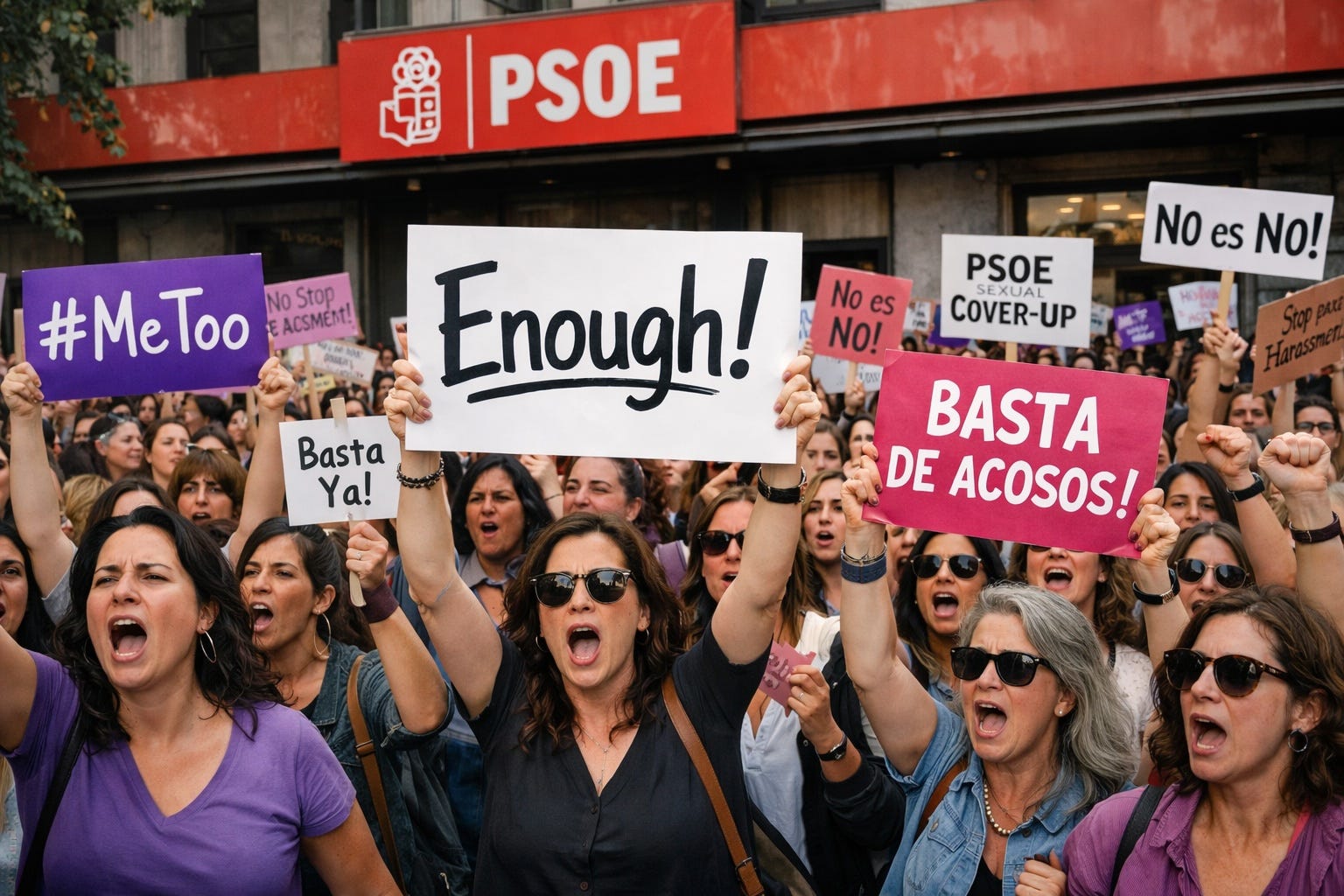
🌹 PSOE's #MeToo Moment
Plus: Elections (kinda), a Spain-Epstein connection, and a corruption scandal hits Vox.
Madrid | Issue #130
🇪🇸 The Bubble is Spain's #1 English-language, best-selling newsletter. We offer paid subscriptions, and we’d be thrilled to have your support!
🚨 Customize your subscription! You can personalize your Bubble experience so you only get the emails you want—and never the ones you don’t. Click here to learn how.
📺 Sponsorship opportunities. Want to get your brand in front of our engaged and influential audience of professionals, creatives, and government workers? We’re now offering a variety of ways to do so. Click here to find out how and book a spot.
A PR nightmare before Christmas
🚨 PSOE’s #YoTambien moment is a full-blown identity crisis
Spain’s governing PSOE socialist party is in trouble. Remember last week we mentioned how multiple people accused Paco Salazar (a longtime party figure and former senior adviser to PM Pedro Sánchez) of sexually harassing women who worked under him? Turns out that was just the tip of the iceberg.
The case has metastasized into multiple allegations, resignations, internal rage, and warnings from government allies that the legislature is going off the rails.
What’s happening (and why is it so toxic?). This isn’t just another scandal. This is a spiritual crisis for a party that built its brand on women’s rights and is now accused of failing women inside the house, while Sánchez is already weakened by corruption headlines and little support in parliament.
The opposition smells blood in the water, especially with some PSOE allies saying it looks “difficult” for the Sánchez government to keep on keeping on.
Domino effect. Once the Salazar scandal exploded, the PSOE acknowledged “errors,” apologized to victims, and insisted there was “zero tolerance”, but many in the party felt leadership’s reaction was slow, defensive, and too focused on damage control.
But, worse. Not only that, but it also triggered a deluge of similar accusations involving other party leaders who were apparently behaving badly (with no one doing anything about it).
Who’s on the list? The names tied to the #MeToo shockwave include:
Francisco “Paco” Salazar (Sánchez adviser) left his roles after allegations; PSOE said his conduct was a very serious violation.
Antonio Hernández (Salazar’s close collaborator) was removed amid claims he may have enabled and/or covered up what was happening.
Antonio Navarro (Torremolinos PSOE leader/councilman) was the subject of a case that escalated to prosecutors after the complainant felt the party's response wasn’t enough.
José Tomé (Monforte de Lemos/Lugo provincial leadership) stepped down from one role but tried to hold onto others, fueling the sense that PSOE is applying “tough talk, uneven consequences.”
Javier Izquierdo (federal leadership/senator) resigned after a report pointed to a potential harassment allegation.
Toni González (Almussafes mayor/PSPV #2 in Valencia province) resigned from party roles amid an internal probe but didn’t immediately quit as mayor, extending the scandal drip-drip-drip.
Francisco Luis Fernández Rodríguez (Belalcázar mayor) resigned after allegations involving harassing messages.
Official response. PSOE’s public posture has been to apologize to the presumed victims, promise tougher internal processes, deny a cover-up, and insist the party is acting “forcefully and transparently.” Sánchez tried to frame it as being feminist doesn’t make you infallible, but it does require you to act decisively.
But allies aren’t happy. The real danger for Sánchez isn’t just attacks coming from the right, it’s also allies and junior partners in Parliament publicly losing patience.
Yolanda Díaz, from leftish coalition Sumar, called for a deep government reshuffle, basically saying cosmetic fixes won’t cut it.
Gabriel Rufián, from the Catalan leftish/separatist ERC went for the throat, criticizing PSOE’s handling of internal complaints and urging real protection for women who report.
Aitor Esteban, from the Basque PNV, even issued the kind of warning that’s not just rhetoric. He said, stop the “hemorrhage” or consider elections.
And the opposition speaks. PP boss Alberto Núñez Feijóo is wasting no time and is using the scandal as evidence of “structural” rot, bundling harassment and corruption into one big “Sánchez must go” narrative.
Santiago Abascal, from far-right Vox, is doing what Vox does: labeling PSOE a danger to women while dragging the debate back to the failed “only yes means yes” law as a culture-war weapon. (Side note: this morning Vox’s social media boss resigned after being accused of sexually harassing a minor).
What this means for the party. Even if PSOE contains the crisis internally, politically the brand damage sticks, because it lands on top of older feminist-policy controversies that already strained credibility, including the backlash around the “only yes means yes” law.
And there’s more. When you add public anxiety about protection systems, like the ongoing problems with monitoring bracelets for domestic abusers and whether the state is actually keeping their victims safe, the party’s “we are the shield” messaging gets harder to sell.
PSOE is trying to survive this by apologizing, making promises, and attacking offenders. But the problem is that the story now looks less like isolated bad actors and more like a party that didn’t listen until it was forced to.
More news below. 👇👇
🔔 But first, check out our Instagram account
If you’re not following us on Instagram yet, you’re missing out. We’re posting exclusive content with our collaborators across Spain, breaking news updates, and pop culture coverage. Click on the post above and come hang with us!
💬 Five things to discuss at dinner parties
1. 🚐 Sánchez announces a transport card that might not take you very far
PM Sánchez made a big announcement at his political year-end wrapup Monday. That is, the government will be rolling out a national transport card that will be valid across the country on both train and bus, for the low, low price of €60/month for Big People and €30/month for La Juventud.
That sounds fantastic. But to say the card is not all that it seems would be a vast understatement. In fact, it actually takes longer to list where you can’t use the card than where you can. But before we get into that, let us tell you the idea.
The idea was inspired by the Deutschlandticket. That’s Germany’s national transit card, which for €58/month (rising to €63/month on Jan. 1, 2026) lets you travel on all local and regional public transport (but not on long distance trains or buses).
The Deutschlandticket needs subsidies. The central and regional governments each put in €1.5bn (so, €3bn in total) to subsidize the scheme. That has not been enough, hence the ticket raises (from €49 to €58 and now €63).
Spain’s version. The ticket Sánchez announced isn’t new. Óscar Puente, the Transport Minister (and massive overpayer for podcast productions, but that’s another story), floated the idea in January, with more or less the same parameters as the ones Sánchez just announced.
We have doubts. At the time, Spain’s autonomous communities — especially Madrid, which has the most public transport users — voiced, um, reservations about the plan. Specifically? Well, who’s gonna pay for the upgrades and increased services, who’s gonna run the thing (local and regional governments control their own transport systems)?
Where does that leave us now? It appears that Sánchez made Monday’s announcement without getting any local or regional governments on board — though he said he “hoped” they would sign up. So when it rolls out mid-January, the only places where the new card will be valid is on state-controlled transport: Cercanías trains, middle-distance Renfe rail (not high speed), and state buses. That is, no metros and no local or regional buses.
Mutual distrust. There’s not a lot of love lost between the PSOE/Sumar central government and regional ones run by the PP (the majority of Spain). That suggests that a few PSOE and aligned comunidades may sign up, but even they may not be game under the government offers real subsidy money. And judging from the PP recently, it seems they might hold off until after the national elections. (Madrid also said that joining would “raise transport prices” in the region.)
So the service may be limited for a while. Still, a national card is probably the future, so it’s not a bad idea. But it might have been better if it were meant to work, not just as a campaign tool, right?
2. 🛖 Spain whacks Airbnb with a €64m (‼️) fine
The Spanish government’s war on housing unaffordability hasn’t done much to increase supply, decrease demand, or lower prices. But it really has done a great job kicking the bejeezus out of the piñata known as Airbnb. This week’s example? The €64m fine the Ministry of Consumer Affairs just dropped on the housing platform.
A bit of history. In October 2024, the Ministry warned Airbnb that they had some 65,000 listings without required license numbers. Airbnb did nothing, so the ministry started to impose penalties, which led Airbnb to appeal to the Ministry and to the courts. The courts ruled against Airbnb twice, after one of which the Ministry again ordered Airbnb to remove the listings. In July, Airbnb finally cried “Uncle!” and took them down.
Fixed, right? Wrong. According to Pablo Bustinduy, the Minister of Consumer Affairs, his ministry can impose the penalty — equivalent to six times the profit made by the company during the time the illicit advertisements were published — because the courts ruled against Airbnb. Taking the listings down (late) wasn’t enough to reverse the fining process.
Cue soaring rhetoric. “We will defend consumer rights, no matter how large or powerful the companies involved in abusive or fraudulent activities may be,” Bustinduy said.
Will Airbnb be surprised? At least sad. In July, when Airbnb took down the listings, it made a big deal of how closely it was working with the Ministry of Housing, which was about to begin enforcing new short-term rental laws, to ensure that the apartments on its site were correctly registered and to remove those that weren’t. And after Monday’s fine, Airbnb told the BBC it was “confident that the Ministry of Consumer Affairs’ actions are contrary to applicable regulations in Spain“ because, if effect, the new Housing rules had superseded the Consumer Affairs ones.
Differentiating themselves? Here’s a theory: The Ministry of Housing is run by the PSOE, while Consumer Affairs is run by the further-lefties of Sumar, who right now want to differentiate themselves from the PSOE, and all its sex scandals, and show how they are standing up against The Man. This could help.
The “crazy communist.” Bustinduy loves poking The Man. He’s the guy who fined Ryanair €107m for charging extra for cabin bags, leading Ryanair
bossüber troll Michael O’Leary to call him “a crazy communist” — and when the European Commission opened a case against Spain over its ban on the extra charges, to demand he resign (unlikely).More soaring rhetoric. Here’s what Bustinduy said about Airbnb: “In this country, the law will be upheld, especially in the housing sector, to put an end to the speculative practices that are suffocating millions of working families.”
About those speculative practices. Spain has about 400,000 homes designated for tourist rentals, or 1.38% of the total stock (according to INE data crunched by El País). In some city districts, this figure exceeds 10%, and on some streets, it can rise above 30%. There, the Airbnb crackdown could have some effect, but the big problem remains — the lack of new housing.
3.🗳️ Extremadura and Aragón will hold elections soon (we know you don’t care, but you should)
Election time! Spain is heading into another round of early regional elections, and this time the spotlight is on Extremadura and Aragón, two conservative-led regions where the PP has pulled the plug early, not because it expects a political earthquake, but because governing with Vox has become increasingly annoying unworkable.
The trigger is the same in both cases. Vox blocked the budgets and broke the coalitions, leading the PP to decide that calling voters back to the polls is preferable to continuing paralysis (democracy can be so annoying… ask the Gen Zers if you don’t believe us!).
Extremadura votes first. The western autonomous region votes Dec. 21. Polls suggest the move won’t radically change the balance of power. Regional president (aka governor) María Guardiola is expected to win comfortably, improving her current results and coming close (but not quite reaching) an absolute majority.
Guardiola’s gamble is political as much as numerical. Since taking office, she has positioned herself as one of the PP’s most moderate figures, drawing clear red lines against Vox’s rhetoric on immigration, gender violence, and minority rights.
That stance blew up her coalition last summer, when Vox walked out after she refused to back hardline positions on unaccompanied migrant minors. Guardiola framed the split as a matter of principle, arguing that she would not violate human rights or stigmatize migrants, even at the cost of political stability.
Vox has taken it personally. Party head Santiago Abascal has gone on the offensive, attacking Guardiola with language that has largely reinforced her centrist credentials.
Bad lady. He has accused her of embracing “feminist fanaticism,” likened her to leftist former Minister of Equality Irene Montero (!!), and claimed she “betrayed” the political change voters demanded.
Party pooper. For Abascal, Extremadura was supposed to prove that a PP-Vox axis could deliver a sharp rightward turn. Guardiola, in his telling, ruined that.
National PP leader Alberto Núñez Feijóo has taken a more pragmatic tone. All but ruling out an absolute majority in Extremadura, he’s openly acknowledged that the real objective is to outperform the left enough to lower Vox’s leverage.
But, but, but… The PP will almost definitely need help from Vox (or another party) to pass laws. So Extremadura won’t resolve the PP’s Vox problem; it will merely reset it.
Aragón is next. On Feb. 8, the region will hold its first-ever early elections after regional president Jorge Azcón followed the same path as Guardiola.
The reason? The same. Vox left the governing coalition and then blocked the budget. The PP has decided that governing without accounts was unsustainable. Now Azcón is hoping that fresh elections will strengthen his hand and reduce dependence on the far right—but polls suggest a déjà vu outcome.
Why you should care. Aragón and Extremadura matter because they sit at the heart of the PP’s broader strategy. The party is rolling the dice in these regions, hoping that incremental gains will break Vox’s veto power. So these elections are a test of the right’s future.
The questions to answer. Can the PP govern without embracing Vox? Can it present moderation as a strength, not a weakness? And can it escape a cycle where early elections change little?
4. 🕵️♂️ Ana Obregón says the “perfect man” she says she never loved was…Jeffrey Epstein ⁉️
This celeb drama was definitely not on our bingo card. And then, BOOM, it exploded in the Spanish media. The thing is, the plot twist didn’t come from ¡Hola! or Lecturas, but from — brace yourselves — the New York Times, which on Tuesday casually dropped a bomb into Spain’s celebrity ecosystem.
Back in the day. According to the Times, Ana Obregón — the actress, socialite, and omnipresent TV figure of the 1980s and 1990s — briefly dated Jeffrey Epstein in the early 1980s, back when he was still cultivating his “mysterious financial genius” act and long before the world learned he was a serial abuser and sex trafficker and in the running for “Worst Person Ever”.
Their first date, as described by the Times, is almost offensively 1980s NYC. Epstein picks Obregón up in a Rolls-Royce and speeds her around Manhattan. She’s charmed, intrigued — but, she later insists, uninterested. In her 2012 memoir (written after Epstein had already been convicted as a sex offender), she described him as “the perfect man I never fell in love with.”
Yes, that sentence exists. 🤢
The relationship wasn’t just social. During that period, Epstein was hired by Obregón’s family — along with several other wealthy Spanish families — to help recover millions lost when the brokerage firm Drysdale Securities imploded (and took their money with it). The Times reports that Epstein and a former federal prosecutor eventually tracked the missing assets to the branch of a Canadian bank in the Cayman Islands, flying down to retrieve bond certificates and securing Epstein a hefty payday.
Cue Spain’s collective record scratch. This is the moment when all Spanish media went “OMG we made it to the NYT!” and then rewrote it in, like, Spanish. At which point Ana realized this was a thing.
Obregón responded quickly on Antena3. She insisted she never had a romantic relationship with Epstein. Yes, she knew him. Yes, he helped her family financially. But no, she says, there was no affair, no intimacy, and “not even one night of love.”
Not even a held hand. She recalls telling Epstein she had a boyfriend at the time (Miguel Bosé, casually), stopping him when he once took her hand, and ultimately keeping things strictly platonic.
Still… “Little by little, we started seeing each other every day for breakfast at 6:30 in the morning,” she said.
On the bonds recovered by Epstein? “I don’t know for sure. I can’t say yes, no, or the opposite,” she said.
This is obvious. Being linked to “a depraved monster,” she said, is, “asqueroso.”
This may be predictably weird for Ana. This story lands differently when filtered through the Ana Obregón Extended Cinematic Universe. This is, after all, the same Ana Obregón who in 2023 stunned Spain by a) having a baby via U.S. surrogacy at age 68 and b) revealing that said baby was not her daughter — but her granddaughter, conceived with sperm from her late son, Aless. 😯Ana, you live your dream, girl!
So, did Ana Obregón once orbit Jeffrey Epstein? Absolutely. Was it romantic? She says absolutely not. We’re just happy she didn’t have his baby.
5. 💰 Vox faces a corruption scandal over youth group’s donation scheme
Having a scandal is so 2025. Vox is dealing with one of its most damaging scandals to date (beyond, like, saying nasty things about muslims) after accusations of a donation scam involving Revuelta, a far-right youth organization that has operated as a de facto satellite of the party.
Show us the money. Spanish prosecutors are investigating whether funds raised to help victims of the deadly DANA floods in Valencia were improperly, ahem, “diverted”, following complaints from former Revuelta leaders who say that large sums of donated money never reached the people they were meant to help.
Nope, it’s not there. Revuelta allegedly raised hundreds of thousands of euros through donations, membership fees, and merchandise sales, promising that the funds would go to flood victims. Instead, much of the money allegedly sat in bank accounts for months, was routed through a legally unrelated association, or may have been used for other expenses. Whoopsie!
What has made the scandal explode politically is the revelation that Vox’s leadership appears to have known about the problem long before it became public.
We’re listening. Leaked audio recordings published by El Mundo show senior Vox figures, including European lawmaker Jorge Buxadé, one of Santiago Abascal’s closest allies (and a man with a very whiny voice), pressuring Revuelta leaders to dissolve the organization and liquidate its accounts quietly.
This could look bad. In the recordings, Vox officials openly worry about reputational damage and acknowledge that if the case reached the media (hello!), the inevitable question would be whether Vox knew about the irregularities and chose to do nothing.
We don’t know them. Once the audios became public, Vox moved quickly to distance itself. The party filed a complaint against Revuelta with Spain’s whistleblower protection authority and insisted that Revuelta “is not part of Vox.”
Nothing to see here. Party spokespeople have framed the issue as an internal problem of an independent group, despite the fact that Revuelta’s founders were Vox members, several of its leaders were on Vox’s payroll, and its street protests were openly encouraged and attended by senior party figures.
We don’t know nuttin’. Revuelta, which is denying all of this, emerged in late 2023 as a militant youth movement tied to the far-right ecosystem, gaining visibility by organizing aggressive demonstrations outside the Socialist Party’s HQ in Madrid against the amnesty law for Catalan separatists.
Seizing the moment. Other parties are calling for the case to be examined in Parliament and have not ruled out summoning Vox leaders, including Abascal, to testify.
You know who’s low-key enjoying this? The PP, as they are very much aware that every scandal tied to Vox (which has been growing in the polls) favors them. Between this and the PSOE’s never-ending corruption dramas and sex scandals, they are looking like the adults in the room right now. 😇
🙏 Once again, please remember to share this newsletter with your friends on social media. The more we grow, the more information we’ll be able to offer each week.
We’ll be back Jan. 8, after a much-needed holiday break.