



Madrid | Issue #132
🇪🇸 The Bubble is Spain's #1 English-language, best-selling newsletter. We offer paid subscriptions, and we’d be thrilled to have your support!
🚨 Customize your subscription! You can personalize your Bubble experience so you only get the emails you want—and never the ones you don’t. Click here to learn how.
📺 Sponsorship opportunities. Want to get your brand in front of our engaged and influential audience of professionals, creatives, and government workers? We’re now offering a variety of ways to do so. Click here to find out how and book a spot.
A legend is canceled
💥 Julio Iglesias, Spain’s biggest pop icon, is facing an explosive sexual assault case
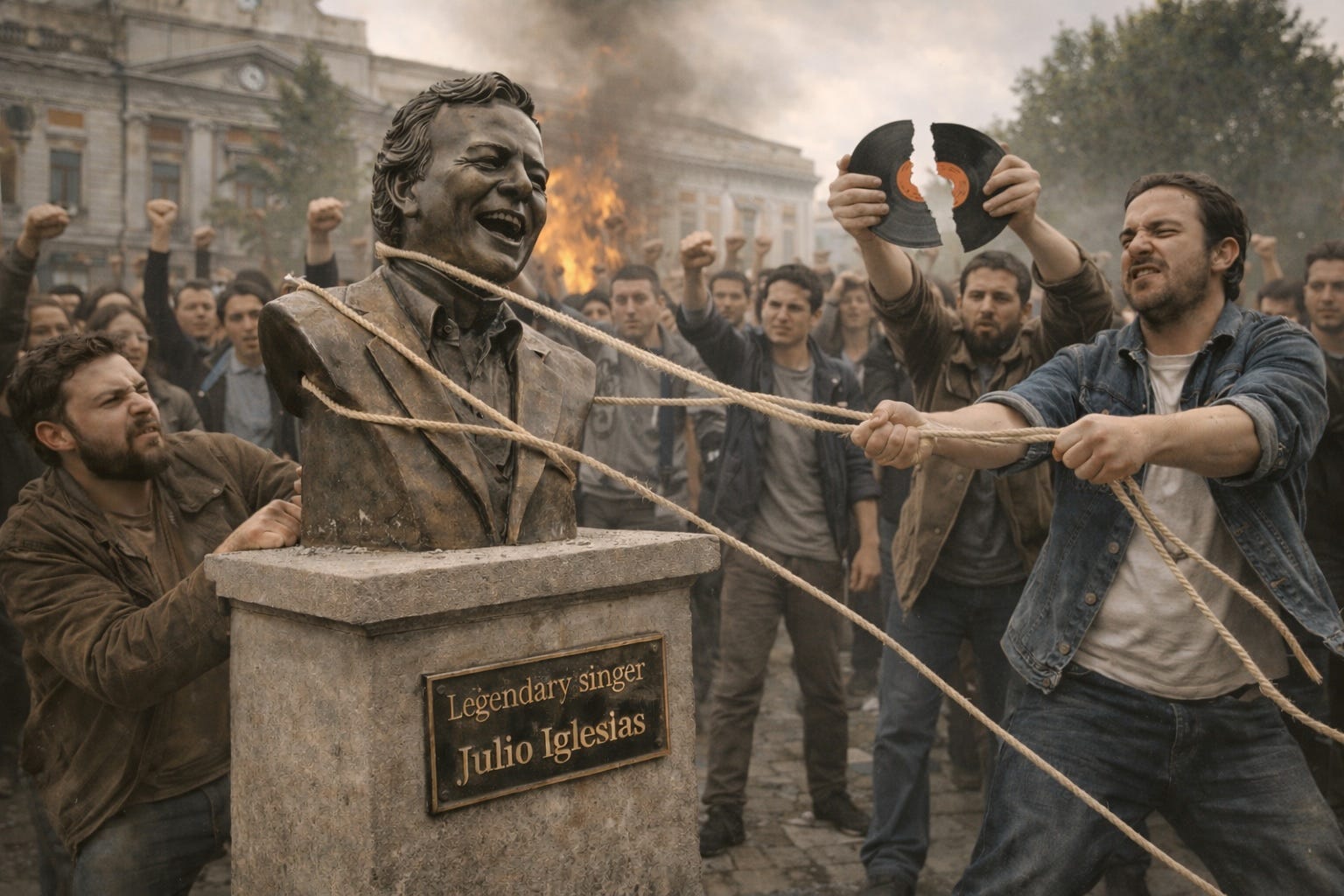
Is the most day-glo radioactive story in Spain this week a) electoral polling, b) Venezuela, or c) the latest PSOE–PP fights? None of the above! It’s the sudden and spectacular explosion of a #MeToo-style case involving one of this country’s most famous cultural exports.
Julio Iglesias, an artist whose name functions as shorthand for an entire era of Spanish soft power, has been accused of sexual assault and forced labor by former domestic workers.
The big reveal is the fruit of a three-year joint investigation by elDiario.es and Univision Noticias, which involved interviews with more than a dozen former employees, hundreds of documents, and two key testimonies that form the core of the accusations.
The allegations center on two women, both in their twenties at the time, who worked for Iglesias at his Caribbean properties in the Dominican Republic and the Bahamas. The alleged events took place in 2021, when Iglesias was 77, and the youngest of the women was 22.
Lots of documents. According to their statements, which the media outlets said were corroborated by documents, messages, visas, photos, and other evidence reviewed by the reporters, both women describe an environment of coercion, humiliation, and — the big one — sexual aggression.
Gnarly nighttimes. One of them says she was pressured into nightly encounters in Iglesias’s bedroom, describing finger penetration, slaps, and verbal humiliation without her consent, often in the presence of a female superior who allegedly participated in and facilitated the abuse.
Unpleasant workplace. The other woman, who worked as a physiotherapist, recounts unwanted touching and kissing in semi-public spaces such as the beach or the pool, as well as a working atmosphere marked by intimidation.
Iglesias’ legal team has so far declined to respond to the accusations, but Julio himself briefly spoke yesterday to ¡HOLA! (aka Hello! Magazine, no surprise there) to say “the truth will come soon and it will all be clarified”. Um, okay.
Spain gets involved. Because Iglesias is Spanish, the case has landed in the Spanish legal system.
Local complaint. Assisted by the international organization Women’s Link Worldwide, the two women have filed a formal complaint before the National Prosecutor’s Office, accusing Iglesias of human trafficking for forced labor and sexual assault, along with a battery of related offenses involving labor rights.
Always a Spaniard. Turns out Spanish law allows these crimes to be prosecuted domestically under the principle of personality, meaning Spain retains jurisdiction over alleged crimes committed abroad by Spanish citizens.
The reaction. Inevitably, chaos ensued. The revelation drew shock, indignation, pushback, and just old-fashioned, bizarre commentary. Talking about bizarre…
Madrid regional presi Isabel Díaz Ayuso was the first major politician to speak. On Twitter, she said that the women being attacked and raped were in Iran, the crimes committed with the complicity of the far left. Then she said Madrid would never contribute to the discreditation of “the most universal singer of all: Julio Iglesias.” Whether she was trying to link the two (to accuse the left of hypocrisy?) or these were meant to be two unrelated tweets, no one but her social media manager will ever know. 🤷♂️
Not my words. Within 24 hours, PP boss Alberto Núñez Feijóo publicly distanced himself from Ayuso’s stance, reminding reporters that the justice system should decide on Iglesias’s guilt.
The government stated the obvious. Equality Minister Ana Redondo tweeted that she hoped the case would be “investigated and taken to its full conclusion.” Now, let’s not forget the Socialist Party is still dealing with their own #MeToo hangover.
Finally, there’s television. That’s where things went nuts.
Ana Obregón, noted friend of Jeffrey Epstein and mother of her own son’s child, wondered on air if receiving an all-night blowjob (as Iglesias reportedly demanded of one of the women) would give a man blisters, and asked the co-author of the El Diario investigation how much money the women had charged for their testimony (”Zero euros,” the journalist answered, visibly annoyed).
The archives. Once the Pandora’s box was opened, people began analyzing every shocking episode from Iglesia’s past, from the moment on live TV when he forces Argentine host Susana Giménez to kiss him, to the crazy allegations from an ex-girlfriend 15 years ago, to his odd relationship with his wife.
This is a big, big deal. Julio Iglesias is the most successful Spanish recording artist of all time — he’s sold nearly 250 million records worldwide — and a global celebrity whose voice and persona defined a generation.
That’s why the story hit so hard. The speed with which the Iglesias case has moved is a reminder that Spain has changed since “To All the Girls I’ve Loved Before” was released in 1984, and it may have to confront how many other dark tales its celebrity culture, built in a time when consent and labor rights were more optional, might have hidden under the rug.
More news below. 👇👇
🔔 But first, check out our Instagram account
If you’re not following us on Instagram yet, you’re missing out. We’re posting exclusive content with our collaborators across Spain, breaking news updates, and pop culture coverage. Click on the post above and come hang with us!
💬 Five things to discuss at dinner parties
1. 🤷 Sánchez’s new housing bill gets shot down before it takes a step (and by his “friends”!)
Notice a guy on the street mumbling, “Man, I can’t win for losing”? That’s PM Pedro Sánchez.
Example 248: His new housing law. You see, he’s been down because everybody’s been banging on about how like half his close PSOE buddies are in pre-trial detention — and his brother and wife might even face trial. So he must have been like, “I got it! We’ll roll out something to keep rental prices down. People will dig that 💯!” Why? An estimated 600,000 cheap COVID-era rental contracts expire in 2026, setting renters up for brutal 35–40% hikes. So, good idea, right?
BobPedro the Builder. Speaking Monday at a Madrid housing site in a high-vis safety vest (but no hard hat because, dude, the hair), Mr. Handsome announced that “in the coming weeks” his government would introduce a decree law that would refund the taxes landlords pay on rental profits if they froze rents, as well as limit the prices landlords could charge on room-by-room rentals. “This way we all win,” he said. Bet he expected a big hug!
Didn’t work out that way. First came the PP, which at this point just opposes Sánchez out of muscle memory. Party boss Alberto Núñez Feijóo rolled out his own housing plan within hours, and it was heavy on build more, cut red tape, give landlords legal certainty, and very light on, you know, freezing rents.
But here’s where it gets really awkward for Mr Handsome. The real firing squad wasn’t on the right. It was standing directly behind him.
Sumar, his own coalition partner, basically spat out the proposal like a hairball. Party kingpin Yolanda Díaz warned that “gifting” public money to rentiers was, like, a “grave error” 😱, and Social Rights Minister Pablo Bustinduy went harder, calling the plan “ineffective” and “unjust” and saying flat out that Sumar wouldn’t support it.
Then the formerly important Podemos showed up with a tank of gasoline. Party leader Ione Belarra promised to vote no, while MEP Irene Montero demanded that “the streets must burn” 🔥 until the housing crisis is solved. (Always a crowd favorite.) EH Bildu and ERC piled on, calling the tax break a “scam” and warning that if the progres don’t legislate against speculation, “the left is going to hell.”
Here’s the kicker. What Sánchez’s partners really want is an obligatory extension of contracts — no carrots, just a stick — imposed by decree, just like during COVID. It polls great, right? Well, if you don’t own a rental.
The only problem? That whole capitalism and private property thing — plus the Constitution — really doesn’t like it.
2. 👀 Vox surges toward 18% as PP bleeds and PSOE plunges

Surprise! The latest polling from El País (40dB) and El Español confirms a trend that has been visible for months: far-right Vox is consolidating support, and the gains are coming directly from both the center-right PP and the center-left PSOE.
The 40dB/El País poll now places Vox at almost 18%, up 5.5 points since the 2023 election, making it the fastest-growing national party. (Importantly, the survey captures the period following the U.S. capture of Nicolás Maduro in Venezuela, which Vox embraced without hesitation.)
A separate poll from El Español shows a similar result, projecting that Vox could surpass 60 seats and be competitive with the PSOE in parts of Andalusia and Murcia.
And the PP? In an awkward position. 40dB/El País gives it 31.5%, half a point more than the previous month but nearly two points below its 2023 result.
The headline number hides the real issue, which is that Vox is feeding on PP voters. According to the transfer data, 13% of PP voters from 2023 would now switch to the party of Santiago Abascal, while barely 2% would do the opposite, suggesting that the right is not fracturing so much as being rebalanced on Vox’s terms.
Hard gulp. The PSOE’s picture is no brighter. The Socialists fall to 27.1% in the 40dB/El País barometer, down seven tenths since the last survey and nearly five points below their electoral result. Yikes!
El Español estimates they would lose 19, dropping to 102. The hemorrhage is diffuse: PSOE leaks voters to the PP, to Vox, and to Sumar, but above all to abstention and indecision, which now absorb more than 15% of its 2023 electorate. Erosion in multiple directions is harder to correct than a single, clean shift.
The kids aren’t alright. But the most notable data point is related to age, as Vox now leads among Spaniards aged 18 to 34, and its advantage is strongest among those aged 18 to 24, where it reaches 22.6%, more than 11 points ahead of the PP and four points ahead of the PSOE.
The PP performs best over 65, and PSOE does reasonably well between 35 and 64, but the left faces a generational problem that goes beyond turnout. Increasing numbers of young voters are not just indifferent to them, but actively making goo-goo eyes in the opposite direction.
Taken together, the polls show a right-wing bloc with a 13-point advantage, a left fragmented by the collapse of leftist Sumar and the modest survival of far-left Podemos.
Were you thinking of moving to Spain to escape Trump? Um, maybe try Bhutan.
3. 🙊 Don’t referencies that, you dumb groupie! Pérez-Reverte vs. the RAE’s new words
There’s one thing we look forward to each December even more than hating on listening to Mariah Carey. The Real Academia Española’s annual drop of newly “acceptable” words for the Diccionario de la Lengua Española. For Americans raised in the glorious chaos that is English, it’s oddly cute — like Spain has a linguistic bouncer checking IDs at the nightclub door.
But not everyone is so thrilled. This week, Arturo Pérez-Reverte — the bestselling novelist, professional curmudgeon, and elite-level media troll (we mean that affectionately) — penned a scathing opinion piece in the right-leaning El Mundo in which he basically ripped the RAE a new 🫏🕳️ (classy, we know) for abandoning its famous motto adopted in 1713: “Limpia, fija y da esplendor.”
Oh, do tell! Well, Pérez-Reverte’s argument is basically a three-act disembowelment.
Limpia (Clean). The RAE isn’t supposed to just record whatever gets said on TV or shouted on X. It should warn against sloppy, unnecessary, or confusing uses — especially for students, teachers, and non-native speakers who need stable references. Basically, Arturo says, if “it’s used” automatically becomes “it’s valid,” then congrats, we’ve reinvented vibes-based grammar. 😝
Fija (Fix). Fixing doesn’t mean freezing the language, he adds. It means providing anchors — consistent guidance — instead of endless “depends,” “optional,” “recommended but not required.” “An institution that does not establish a fixed standard, doubts; and one that doubts, ceases to be a reference point,” he says. So give us some clarity, damnit! (He didn’t say that; we did.)
Da esplendor (Give splendour). The RAE should defend Spanish as a cultural heritage, not chase the tone of social media clapbacks. His nightmare scenario: the academy becomes a notary for the loudest illiterate influencer instead of a steward of literary Spanish. “An illiterate pundit, YouTuber, or influencer can have more linguistic influence than a Cervantes Prize winner,” says an irate Arturo. 😡
For example. Pérez-Reverte gets petty (his best mode) with examples. Referenciar, he complains, is an anglicism-cum-redundancy: Spanish already has referir. And groupie? If you’re going to import it, at least admit the saucy part of the meaning — not just “fan who follows a band,” but that kind of weirdly obsessive fan you want to avoid. The RAE leaves that out.
Check the video above for more examples from 2024. Like espóiler (spoiler) and esnórquel (snorkel) — aren’t they just pronouncing English in Spanish? And script — why isn’t guión good enough (and shouldn’t it be escript ☝️?)
Senior academics fired back, saying, “Easy, dude, the RAE is not the Inquisition.” (Our paraphrase.) The language belongs to everyone, not just writers, and the Academy’s job isn’t to prohibit or scold — it’s to orient. Also, they add, dictionaries have always tracked real usage, from great authors to boring administrative texts. Welcome to real life, Arturo.
4. 🌹 Yo, PSOE: The call is coming from inside the house
Pedro Sánchez claims (repeatedly) that he won’t call elections until 2027. But with no majority, thin public support, and—minor detail—no real ability to pass laws, it was only a matter of time before other pols in his own PSOE started positioning themselves to take over his role as PSOE Top Dog when the reckoning comes.
Enter Jordi Sevilla. The 69-year-old ex-minister in the government of José Luis Rodríguez Zapatero published a manifesto-video combo — ‘Socialdemocracia 21‘ — that is as retro as it is earnest, meant to set the foundation of a reborn PSOE. His diagnosis of its current state, tl;dr? Pedro Sánchez kinda sucks for the party. (Shocker.)
Pining for the past? A lot of the manifesto reads like a plea for calmer, more consensus-driven politics — whether or not that golden age ever really existed (though tbh it sounds nice).
Like this. Sevilla calls for an “autonomous, social-democratic, transformative, inspiring, majority-supporting project, focused on the problems of citizens and open to democratic consensus with its political adversaries on matters of state.” Also, he wants to overcome the “dead end” of the “pro-Sanchismo” vs. “anti-Sanchismo” trench war between the PSOE and the PP. Wouldn’t that be nice.
But we focus on the spicy bits. That‘s why we’re looking at his (sorta) veiled criticism of the Sánchez administration.
Like this: “We have replaced social democracy with populism based on electoral calculations.” And this: claiming moves by current PSOE leadership have led to a “rise of the far right” and a “dictatorship of minorities.”
And what about Mr Handsome? Sevilla has previously warned the PSOE was becoming a “Sánchez fan club”, but in his manifesto, he opts for a diplomatic tone: Political parties are “democratic channels of political participation, not dogmatic sects centered around a charismatic leader.” Wonder who that’s about… 🤔
The rollout was deliberately low-key. No big-name signature list. Instead, short testimonial videos from militants and leaders (“Hi, I’m Carmen”) calling for an internal debate. Around 40 PSOE figures have publicly backed the manifesto so far.
Who’s orbiting the effort? Old guard figures like Felipe González and Alfonso Guerra have been briefed, while mid-generation names such as Juan Lobato and Eduardo Madina are watching closely. Sevilla has also spoken with Castilla-La Mancha president Emiliano García-Page, the regional baron most often floated as a future challenger — if and when the dam breaks
Does this change anything today? Not really. But it makes one thing clear: inside the PSOE, the post-Sánchez jockeying has begun. Officially, party leaders say they welcome debate. Unofficially, the tension slipped when Science Minister Diana Morant was asked about the manifesto and replied: “I haven’t read it — among other things, because I’m not interested.”
5.✋ The Prado Museum doesn’t want any more visitors, thank you very much

Everyone’s favorite museum in Madrid has a message for the world: thanks for coming, but we’re good. After hitting a record 3.5 million visitor mark in 2025, director Miguel Falomir says the museum “doesn’t need a single visitor more” and would very much prefer “not to become the Louvre”.
C’est la merde. Have you ever tried to see the Mona Lisa? We have. Waiting in line sucks, and the Prado wants to stay away from that. So for 2026, the decision has been made to have no “blockbuster” shows designed to pump ticket sales and create human traffic jams.
Instead, the museum is rolling out Proyecto Anfitrión, a plan to make the museum visit feel less like airport security and more like, well, a museum. That means more thematic exhibitions, fewer monster queues, optimized entrances (have you ever seen the doors on Paseo del Prado open? We haven’t), smaller tour groups, and a stricter stance on photography.
Falomir’s logic is simple. Most of the Prado’s money already comes from the permanent collection, so it doesn’t need to stage an exhibit on, say, Kim Kardashian every year to pay the bills.
The 2026 lineup reflects this sanity. Under El Prado en Femenino, the museum continues its focus on women patrons and collectors with “The Year of the Three Queens”: Cristina of Sweden’s sculpture, Isabel de Farnesio, and a big show on Mariana of Austria.
There’s also a major exhibition on the influence of Italian Gothic on Spain (A la manera de Italia, launching May 26), and another on Hans Baldung Grien that deliberately leaves the comfortable Spain-Italy-Flanders triangle. (Forget about Jeff Koons or Damien Hirst or any other contemporary stars.)
The Prado’s numbers are pretty great. It’s grown massively in the last 25 years — doubling visitors, increasing its space by 53%, and acquiring 13.500 works.
Combine all that with a frozen budget of €72 million, the long-awaited Salón de Reinos renovation slowly inching toward 2028, and Falomir’s repeated warnings against “delirium” and “paroxysm” (here you go, you’re welcome) à la Louvre, and you get the Prado’s new stance: quality over quantity, because this isn’t a damn theme park.
In Falomir’s wise words, “Going to the museum shouldn’t be like taking the subway at rush hour.” Amen, brother.
🙏 Once again, please remember to share this newsletter with your friends on social media. The more we grow, the more information we’ll be able to offer each week.
My theory is the AI women declined to be in the photo in protest of Julio. (Fine, I know "Ai women" isn't a real demographic group, but anyway...)
I hadn't heard about the Iglesias scandal - possibly the least surprising of all the MeToo scandals. Btw, the AI photo is hilarious: all those men in workers' clothes and burning fires. 🤣🤣....as they do when they hear about a sex scandal. 🤣🤣🤣🤣🤣 Another great informative article!