



Madrid | Issue #115
🇪🇸 The Bubble is Spain's #1 English-language, best-selling newsletter. We offer paid subscriptions, and we’d be thrilled to have your support!
🚨 Big news! Not long after you receive this edition of The Bubble, you will receive it in Spanish. After constant requests from Spanish teachers, language learners, and Spanish speakers who just want exactly what The Bubble offers (quick, snarky, non-partisan news), we are starting this week. This edition of The Bubble en español is free, but to read it in its entirety in the future will require a subscription. Enjoy!
100 million or bust! Well, maybe not
⛵️ Spain’s tourism boat may have just run aground
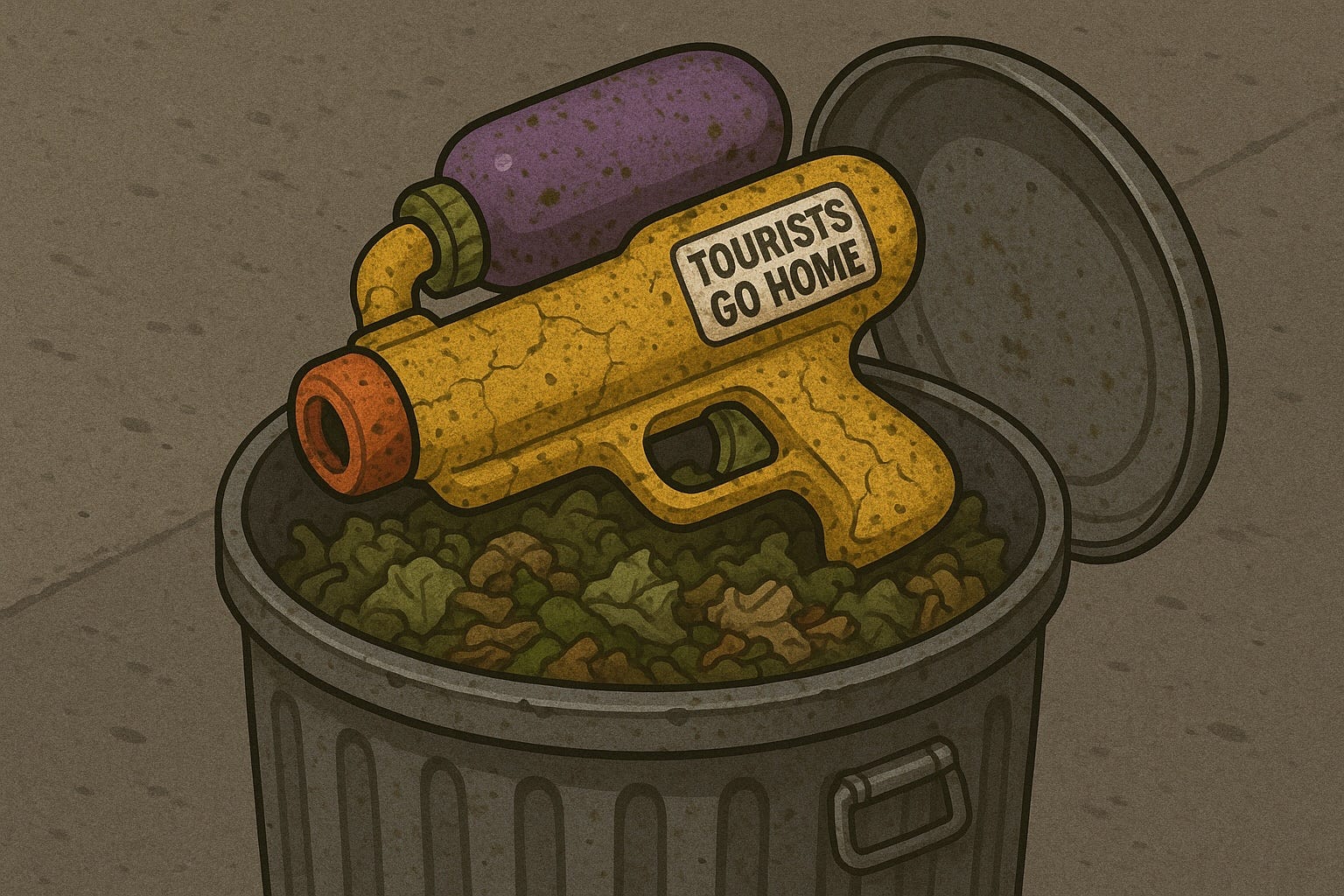
Don’t you like us anymore? For the first time since COVID — and before that, for years previous — Spain is seeing its tourism growth slow down, and in the case of Germans and the French, go backward.
No, seriously. In July, Spain had 11m foreign visitors, a new record for the month but up only 1.6% from last year’s figure. Worse, the number of German visitors dropped 4.8% during the month, and the French were down 3.1%, according to the INE stats service. Say what you will about the French and Germans (and people do!), their money is very welcome in Spain, where tourism accounts for 12.3% of GDP. So, like, it’s important, right?
Just take Mallorca. As we wrote in July, the Biggest of the Balearics has seen a major slowdown in spending. One industry group said average restaurant sales were down 6–8%, with some off 30%. In the words of one server in Palma: “I’ve been here nine years and I’ve never seen it this empty. It’s sad.”
Been a while coming. After big 7% increases in January and February, and a huge 10% jump in April (aka Semana Santa), the number of foreign visitors barely grew in June and July. So, in the name of all beaches that do not suck (and Spain’s don’t), ¿que pasa, hombre? Let us count the ways. Hint: They’re all about 💰.
1️⃣ The economy. Sure, the IMF may expect Spain’s GDP to grow 2.5% in 2025, but its top tourist sources — the U.K., France, and Germany — are barely expected to grow, at 1.1%, 0.6%, and 0% respectively.
2️⃣ Inflation. Inflation in Spain overall has been pretty chill, but in tourist zones, it’s gone off the rails. In the Balearics, prices at bars, restaurants, and hotels are up 5% since last year — and 30% since pre-COVID 2019, according to the INE.
3️⃣ Deals elsewhere. Juan Molas, presi of the Mesa del Turismo industry group, told El País that a major factor has been the more economical options being offered in other Mediterranean destinations like Turkey, Tunisia, and Morocco; or in Adriatic countries such as Croatia, Montenegro, and Albania.
Runner-up. Anti-tourism protests prompted by Spain’s housing crisis — replete with water pistol-packing activists soaking tourists — have done nothing to help. We at The Bubble have heard from several people who’ve passed up Barcelona visits for this. Though to be fair, who wouldn’t want a 🔫 shot of 💦 on a hot August day?
Well, at least they’re richer tourists. Despite the slow growth in the number of tourists, the amount they’ve spent is booming, up 6.1% in July and 7.2% for the year. Then again, if prices are up 5%+ at tourist spots this year, that’s not so impressive…
This won’t help.
Cheap bastardsDiscount airline Ryanair announced Wednesday that it would be cutting 1 million airline seats in Spain by ending operations in the Vigo and Tenerife Norte airports and cutting flights to others. Calling it a “tourism catastrophe,” Ryanair CEO Eddie Wilson said Spain was “currently closed to tourism.”The complaint? The fees that airport operator Aena charges are too damn high. Added to a previously announced cut of 800,000 seats, this means Ryanair will axe nearly 2m Spanish seats in 2025. Aena’s reaction to Ryanair was basically
go fuck yourselfwe respectfully disagree. Which we are sure will definitely lower the temperature on this one…
Maybe next year. No matter what happens with Ryanair, we’re pretty confident that Spain can kiss its goal of 100m tourists in 2025 — remember that one? — goodbye. 💋
More news below. 👇👇
🔔 But first, check out our Instagram account
If you’re not following us on Instagram yet, you’re missing out. We’re posting exclusive content with our collaborators across Spain, breaking news updates, and pop culture coverage. Click on the post above and come hang with us!
💬 Five things to discuss at dinner parties
1. ⛴️ Aid flotilla sails from Barcelona to Gaza (maybe)
The Global Sumud Flotilla, aka the “Freedom Flotilla”, set out from Barcelona on Sunday with a bold plan: sail across the Med, break Israel’s blockade of Gaza, and deliver humanitarian aid. Israel says it will treat them as terrorists. So…there’s that.
The mission has pulled together some 200 people from 44 countries, including Swedish climate star Greta Thunberg and former Barcelona mayor Ada Colau. A coalition of NGOs and activists, it’s funded entirely by donations.
Humanitarian armada. Thirty boats are on the water now, heading for Tunisia and Italy, where 20 more will join. If all goes to plan, roughly 60 vessels and 500 people will form the largest flotilla in history.
Don’t repeat 2010. Organizers say the goal is not just to reach Gaza but to force global attention on the blockade — and push for a humanitarian corridor. Crews have been trained in nonviolent resistance, hoping to avoid a repeat of the 2010 Mavi Marmara flotilla incident, when 10 activists were killed in a clash with Israeli naval commandos.
We do not want you here. Israel, unsurprisingly, isn’t playing along. Officials warn that anyone approaching Gaza’s waters will be treated as a “terrorist” collaborator, not just a protester.
No more Mr Nice Guy. The Israeli government has floated plans to seize the boats, jail participants in prisons reserved for terror suspects, and ensure that no one gets the “soft treatment” given to previous flotillas, where detainees were released within days.
Barcelona, we have a problem. Getting out of Spain hasn’t been smooth.
Try #1. The boats first set sail Sunday to cries of “Free Palestine” — only to turn back that night in high winds.
Try #2. A second attempt on Monday afternoon ended with five vessels limping home after “extreme weather,” seasickness, and mechanical failures.
Success! (Sorta) On Tuesday, most of the flotilla made it as far as Menorca for refueling and safety checks. As of now, a smaller group of vessels is still trying to push ahead, aiming for Tunisia, while others remain stuck in Barcelona, making repairs and waiting for calmer waters.
Storms ahead. If they can push on, the flotilla won’t near Gaza until late September. But if it does, expect a clash at sea.
2. 💣 Alleged rape near Madrid migrant center lights political fuse
A 17-year-old boy has been detained in Madrid on suspicion of raping a 14-year-old girl in the early hours of Saturday morning. The alleged assault took place in Hortaleza’s Clara Eugenia park, close to a center housing unaccompanied foreign minors known in Spain as MENAs.
The spark that turned this case into an immigration bomb 💣. The 17-year-old was Moroccan — a MENA from the center — and the girl was apparently Spanish.
Within hours, the case had sparked a violent backlash. On Sunday night, two masked men attacked three young residents of the Hortaleza shelter, one of whom required hospital treatment.
Government condemnation. Francisco Martín, the government’s delegate in Madrid, condemned both attacks, stressing that those who commit crimes must face the full “intensity” of the law but also warning that “hate speech ends up expressing itself in hate crimes.”
The crime itself was horrifying; the political reaction was predictably combustible. Vox quickly framed the arrest as proof of what it calls a decades-long “invasion” of Spain facilitated by both the Socialists (PSOE) and the conservative Popular Party (PP). "That girl is a victim of Sánchez's policies, a victim of the two-party system's immigration policies,” Vox boss Santiago Abascal said.
The far-right party announced a demonstration outside the youth center, even after the Government Delegation banned it on security grounds (and because it might allow hate crimes to be committed, which sounds a lot like thought-policing, considering many already brand Vox pronouncements as hate speech).
Vox insisted it was a “public declaration,” not a rally requiring authorization, and blasted what it described as “an invasion of the maladjusted.” The group held a press conference, where the press seemed to focus mostly on whether Vox would condemn the violent backlash.
Madrid’s President Isabel Díaz Ayuso (PP) also sharpened her rhetoric. While she has long criticized the central government’s distribution of unaccompanied minors, she had previously drawn a line between linking migration to public safety. In the wake of the Hortaleza case, however, she accused Prime Minister Pedro Sánchez of “multiplying the arrival” of increasingly “aggressive” minors.
Deportation calls. Her administration called for the deportation of the accused 17-year-old and eight other minors on Wednesday, adding to 37 other young migrants it had already deemed too problematic to remain this year.
Match sets fire 🔥. What began as a shocking (alleged) crime in a neighborhood park has quickly become tinder for a broader fight. With one teenager in custody, others assaulted in reprisal, and leaders trading barbs over migration, the fault lines of Spain’s long-simmering immigration debate have now become very real in the streets of northern Madrid.
3. 🔥 Sánchez’s ‘climate pact’ met with political resistance (shocker!)
Literally on fire. As we explained last week, Spain had a lot of fires this summer. Like, literally 0.8% of the country burned. In response, Mr Handsome PM Sánchez announced he would introduce a cross-party agreement to deal with climate change (not just natural disasters). The question is… will the other parties listen or care?
He’s got points. Speaking at the Ministry for Ecological Transition, Sánchez unveiled a 10-point proposal this Monday for his so-called Pacto de Estado, saying he believed it would better prepare the country for extreme weather events like fires, floods, and record-breaking heat waves.
Those were the days. Sánchez framed his initiative as essential to protecting Spain’s future and called for cross-party unity, invoking the spirit of past bipartisan agreements like the country’s anti-terrorism pacts. Considering the unity and trust that mark Spanish politics these days (ha!), we have our doubts.
The plan’s clearest proposal for dealing with things like the Great Fire of 2025 is the creation of a new national Civil Protection and Emergency Agency, designed to improve coordination during disasters.
Other key points include a network of climate shelters to protect vulnerable populations from extreme heat, expanded green infrastructure like shaded corridors, and better protections for workers exposed to dangerous temperatures.
But wait, there’s more! Sánchez also discussed forest fire prevention, calling for permanent funding pools at both national and regional levels to rebuild devastated communities and landscapes, along with year-round staffing for firefighters and emergency crews.
And more! His proposal includes other points such as promoting mixed forests with climate-resilient species, focusing on water resilience to combat droughts and floods, and building a culture of prevention and education.
Nor listening nor caring. Not surprisingly, PP leader Alberto Núñez Feijóo quickly rejected the plan and dismissed the PM’s appeal for consensus, saying Sánchez had “no credibility” after years of “breaking past state agreements” in defense and foreign policy. Feijóo did not, however, comment on whether the creation of the agency or the other plans were good ideas or not.
Yeah, we still have doubts. Since the PP refuses to sign on and Vox pretty much denying climate change altogether, the proposal faces
has no chance in hellfaces an uphill battle.
4. 🏖️ Wait, is Benidorm going big, or going bankrupt?

Benidorm is a contradiction in city form. At one end, quiet Spanish neighborhoods like Cala hold sway; the other, Levante—aka The Garden of Earthly Delights panel #3—is home to daytime lager marathons and competitive sunburning. In winter, it’s a town of 75,000 residents; in summer, it swells to 350,000+ person city.
Cue drama. And now, as the season ends, the headlines make it clear: Benidorm is either going big… or going bankrupt.
Large phallic symbol. On the “boom” side of the ledger, the city has just approved the construction of the TM Tower, a 64-floor, 260-apartment tower off the Poniente beach, which, at 230 meters tall, will be the tallest residential building in Europe. Judging from renders (above), it will resemble a gigantic alabaster sex toy at its expected completion in late 2028.
Not quite a medal, but close. The TM Tower, built by second home construction giant TM Grupo Inmobiliario and designed by Sevilla’s Bakpak Architects, will be the fourth-tallest of all buildings in Spain, just behind the three tallest office towers of the so-called Cuatro Torres de la Castellana. Still, Europe’s tallest residential building—things must be going swimmingly in Benidorm, right?
But, but, but… On the same day that TM and Bakpak announced the towers, El País published an article noting that the city of Benidorm itself faces bankruptcy in the form of a €340m legal judgment arising from a 20-year-old court case. That throws a bit of cold water on the celebration, eh?
The bill comes due. Back in 2003, Benidorm’s then-mayor cut a deal with the Murcia Puchades family: they’d give up land on the Serra Gelada hillside in exchange for juicy development rights elsewhere in the city. Two years later, that same hillside was declared a protected natural park—no building allowed. Fine, said the family, but a deal’s a deal.
But the city never delivered. Years of silence turned into lawsuits. A first court sided with the town, but higher courts flipped it: Benidorm owes the family not just the land’s €280m value but another €60m in interest. Total bill: €340m—or two and a half times the city’s annual budget.
City Hall is now begging Spain’s Constitutional Court for a miracle, warning that without help it will face “technical bankruptcy,” service cuts, and layoffs. Meanwhile, the opposition is calling for Mayor Toni Pérez’s head, accusing him of bungling the case and “mortgaging the future of several generations.”
At least Benidorm’s breaking records, right? Tallest condo tower in Europe and possibly the priciest court loss in Spanish municipal history 🎉👩⚖️.
5. 🇮🇩 Matilde Muñoz’s tragic end in Indonesia
Spain was stunned this week by the discovery of Matilde Muñoz Cazorla, a 72-year-old yoga teacher and former flight attendant from Galicia, who was found murdered in Indonesia after being missing for two months.
Big traveler. Matilde lived in Mallorca but spent half the year traveling through Asia, funding her adventures by renting out her apartment during tourist season.
Indonesia stop. In June, she checked into the Bumi Aditya hotel near Senggigi beach on the island of Lombok (just west of Bali) — a place she’d stayed three times before. Friends and family were used to daily WhatsApp updates. When her messages stopped on July 1, alarm bells rang.
Her family and friends launched an online campaign, sharing her photo in local Facebook and WhatsApp groups. Spanish expat networks in Indonesia mobilized, and even Interpol eventually got involved.
Not so trustworthy. The hotel staff offered shifting stories — at one point even producing a suspicious message from her claiming she had left for Laos. But her relatives never believed it.
How did that get there? Meanwhile, her scooter was found abandoned outside, and some of her belongings, including her backpack, mysteriously appeared in the trash.
Sad finale. On Saturday, the search ended in the worst possible way. Police arrested two men — one a hotel employee, the other a former worker — after they confessed to murdering her.
Their motive? Robbery. They admitted to sneaking into her bungalow through a window, planning to steal from her. When she caught them in the act, they asphyxiated her, wrapped her body in a sheet, and hid it in a storage room.
All for that? Days later, they buried her just beneath the sand on a nearby beach. They killed her for €155 and a debit card they couldn’t even use.
Tech sleuths. Authorities tracked them down using the geolocation data from Matilde’s phone, which the suspects had tried to sell on the black market.
Long time jail or worse. The two men now face charges of premeditated murder and violent robbery — crimes that in Indonesia can carry life sentences or even the death penalty.
Matilde’s family is working to repatriate her body to Spain and fears the case may be mired in irregularities, especially given the hotel’s contradictory statements.
Lies. The hotel misidentified her room, falsely claimed she paid in cash, lied about her scooter rental, and, of course, there’s that fake WhatsApp message full of spelling errors she supposedly sent to a hotel employee. These have fueled the family’s belief that the hotel was involved — or tried to cover up the crime.
Truth will out. For Matilde’s family, justice means not letting her story — or the truth — be buried.
🙏 Once again, please remember to share this newsletter with your friends on social media. The more we grow, the more information we’ll be able to offer each week.
We’ll be back next week with more.