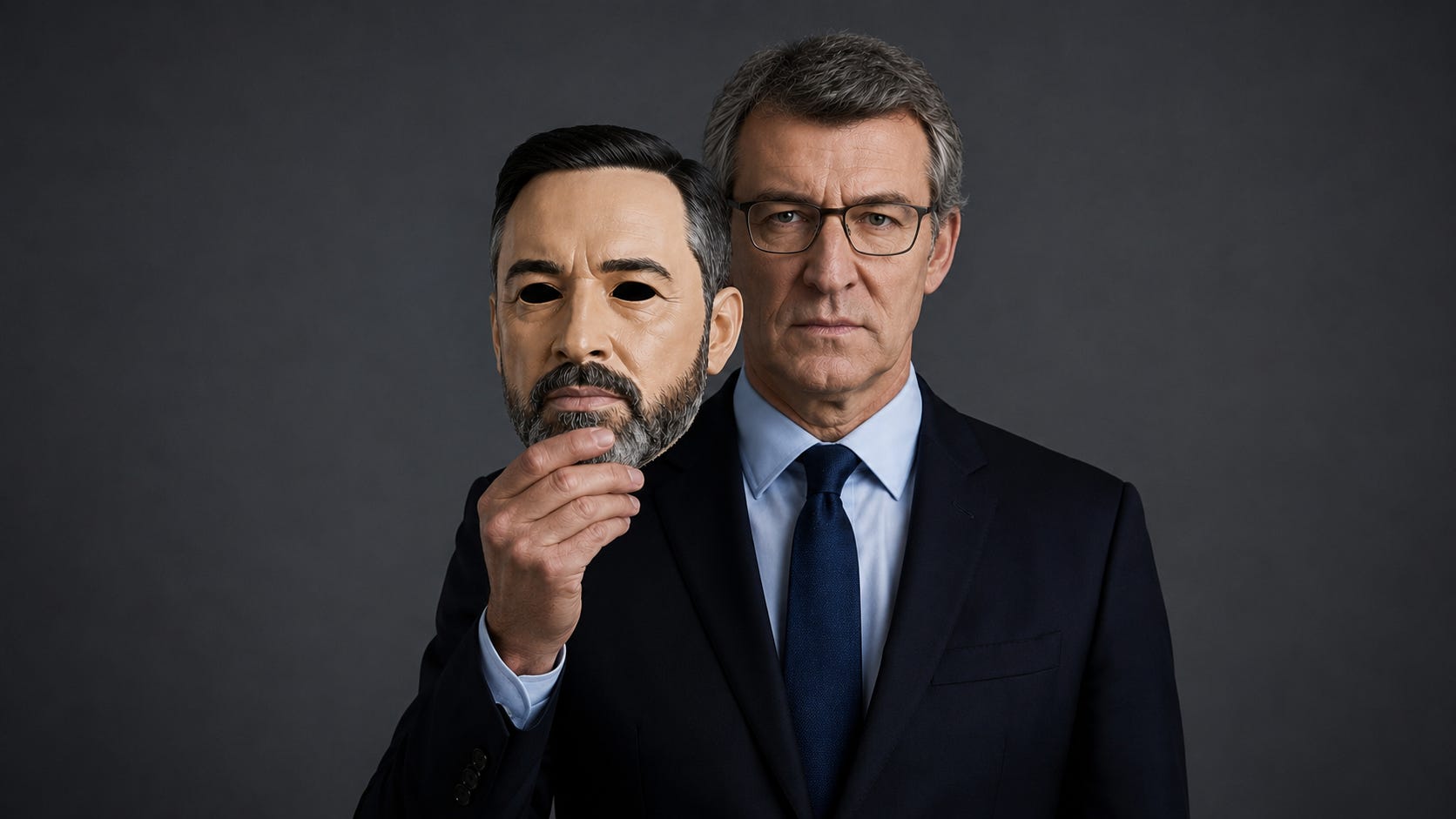
👉 PP cosplays the far right
Plus: Drama at the NATO summit and what the heck is DMOCRACIA?
Madrid | Issue #154
🚨 The Bubble is Spain's #1 English-language newsletter. We offer paid and free subscriptions (which you can customize). Or interested in sponsorship opportunities?Click here to find out how to book a spot.
Starting the engines
🥊 Spain's right prepares its election platform for 2027
Something is shifting in Spain’s political landscape this week. A series of proposals, statements, and deals involving the Partido Popular (PP) shows the party edging further right, both rhetorically and strategically, as it tries to both prepare for 2027 elections (a centrist affair) while at the same time holding off the far-right Vox.
Hint: It's not a pretty dance.
The move. Led by Alberto Núñez Feijóo, the conservative party has tried to position itself as a moderate, center-right alternative to Prime Minister Pedro Sánchez of the PSOE. In recent days, however, it has increasingly operated in terrain that is traditionally dominated by Vox.
Let us count the ways.
1️⃣ The child not yet born has entered the debate. The clearest example of this is Feijóo’s promise this week to take Madrid’s “Unborn Child Law” nationwide.
Pre-birth benefits. The law, recently passed by Madrid’s regional government, led by presi Isabel Díaz Ayuso (PP), allows an unborn child to be counted as a member of the family for administrative purposes. As in, families can access public aid for housing, education, tax benefits and the like, from around week 14 of pregnancy.
The argument. The PP says the move will help families have children by making the economics more possible.
The drama. It’s controversial to some because it looks like a step toward an idea promoted by anti-abortion groups — that a fetus should be treated as a person with rights.
The criticism. While the law stops short of granting fetuses full legal personhood, which would require changing Spain’s Civil Code and clash with Constitutional Court doctrine, critics argue it normalizes an idea that could eventually justify restricting abortion.
The big deal. The PP says it will not roll back Spain’s abortion law, which was upheld in 2023. But some on the left are painting this as a slippery slope and a way to shift the cultural baseline without triggering immediate legal backlash.
Far-right chimes in. Vox, for its part, is delighted — but not satisfied. The party supports the law while pushing for something more radical: full legal recognition of the unborn, which would directly challenge abortion rights.
2️⃣ “Cancer” comparisons = bad. Feijóo told business leaders that workers’ absenteeism is a “cancer” that costs Spain more than €30bn a year. He also questioned why workers on sick leave should earn the same as those working.
Reality check. Before you ask, yes, Spain does have a real absenteeism problem. Around 4.5% of workers are on sick leave, nearly double the EU average, and public spending on it has surged to €18.4bn annually.
Why? The data is complex — linked to an aging workforce, long waiting lists in public healthcare, and rising mental health issues. Honestly, we don't know exactly why rates are so high.
Cue the outrage. Feijóo's suggestion of effectively reducing pay during sick leave touched a nerve. Critics (i.e., Sánchez and government-allied unions) accused him of targeting vulnerable workers and encouraging people to work while ill.
The walkback. The PP walked back Feijóo's words a bit yesterday, with party officials saying he was referring only to fraudulent cases, not genuinely sick workers. 😒
3️⃣ A new, new deal. The PP formalized yet another agreement with Vox to form a coalition government, this time in Andalucía. The part that matters? It includes Vox's “national priority”, a concept that prioritizes access to public services for people with local ties rather than newcomers (i.e., mostly immigrants).
Leaning further right. On migration, the agreement rejects the redistribution of unaccompanied minors and undocumented immigrants, tightens controls on immigrants, and promotes the return of some to their countries of origin — policies that closely mirror Vox’s agenda.
How do the far-righties like it? Vox’s reaction to all this is…complex, and its official stance depends on your media diet.
Happy! The party is pleased, according to the right-leaning El Mundo. Feijóo’s apparent shift validates its stance, and relations between the two parties are now described as a “fully extended hand”.
Sad! Other media (notably the left-leaning El País) suggest something else: Vox actually prefers a stronger, more centrist PP, so the two parties can
fightdivide the right-leaning electorate and maximize the right-wing vote.
And the polls? If this is a strategy, it may be working. Recent polls show the PP and Vox holding a double-digit lead over the left, with the conservative bloc ahead by more than 12 points. Some projections even suggest Sánchez’s coalition could collapse to just over 110 seats — a historic low.
Tail wagging the dog. At the end of the day, it feels like Feijóo is following, not leading, his rivals.
More news below. 👇👇
🔔 Don’t miss the latest episode of The Bubble Podcast!
Episode 2 of The Bubble Podcast is out! We talk about true crime (maybe), how to enjoy this summer’s verbenas, and mistakes foreigners make when moving to Spain.
Subscribe on Spotify, Apple Podcasts, and YouTube!
💬 Five things to discuss at dinner parties
1. 🧯NATO drama puts Spain in the spotlight (again!)
Family gathering. This week’s NATO summit in Ankara was supposed to focus on defense, military spending, and the alliance’s response to instability in the Middle East. Instead, it turned into a political spectacle both in Turkey and here in Spain.
Make Spain pay again. Ahead of the summit, Donald Trump (aka the 🍊 Menace) escalated his feud with Spain, calling it a “terrible partner” and even suggesting the U.S. would cut off trade entirely.
Frustrated! The orange fella's frustration stems from PM Sánchez's refusal to sign up to NATO’s long-term military spending targets or allow the U.S. to use joint bases in Spain in its campaign against Iran.
Sorry, Don! In reality, Trump’s trade threat
means squathas little chance of succeeding. Spain cannot negotiate trade independently as EU policy is set in Brussels. NATO Secretary General Mark Rutte also stepped in to defend Spain, highlighting that it has now reached the basic 2% defense spending benchmark (which is true, although he credited Trump for it).Did you watch the game? PM Sánchez, meanwhile, opted for de-escalation, describing his interactions with Trump during the summit as “cordial” (“we talked about football and golf”) and insisting that relations remain strong. 💝
Hell froze over. Back in Spain, Vox leader Santiago Abascal made the (very) unusual move of publicly criticizing his supreme leader pal Trump — not over Spain, but over… Italy?
Trump’s relationship with Italian PM Giorgia Meloni isn’t doing so great after he said she had begged him for a photo and she denied it. Ahead of the summit, he mocked her, suggesting he needed a restraining order to keep her away.
Fine, I'll say something. Abascal, who has avoided criticizing Trump in the past, this time called the comments “absolutely unacceptable” and warned that allies should not treat each other “like vassals”. Is Vox souring on Trump? 🤔
Begoña, literally grounded. A domestic subplot added an extra layer to the NATO drama. Begoña Gómez, the indicted wife of PM Sánchez, was denied permission to travel to Ankara to attend the summit due to ongoing legal troubles and restrictions, including the seizure of her passport two weeks ago.
Not needed. Despite an official invitation, the court argued that her presence was not essential. However, the court let her travel to Britain to attend her daughter’s graduation, citing stronger judicial cooperation there in case she tried to flee.
Not a table for two? When Sánchez landed in Ankara on Tuesday, he was given two bouquets of flowers — including one that local media said was for his wife. Hopefully, they make it alive to Madrid. 💐
2. 📸 It’s a clothing line. It’s a PR campaign. It’s…DMOCRACIA!
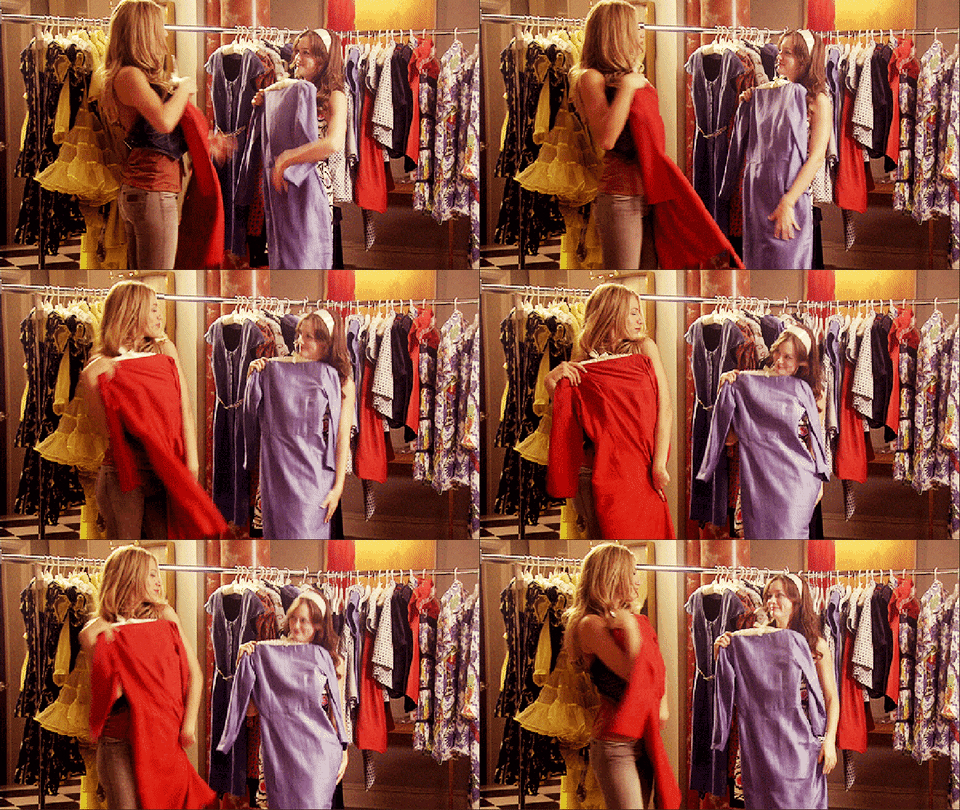
A bunch of attractive influencers wearing unattractive brown-and-gray streetwear sweats vamping through the parliament building with classical-ish cello music in the background, ending with the slogan DMOCRACIA: “When you get dressed, you position yourself.”
It seems pretty innocuous (if a little tacky), right? Well, it triggered a lotta people, most (though not all) on the right.
What’s the dealio? The campaign marks an anniversary the Sánchez government was determined to hit with a bang: 50 years since Franco’s death. The Spain in Freedom commission — a government body set up for the occasion — wanted to reach young Spaniards who didn’t live through the dictatorship and may not think much about it.
Rather than a documentary, they hired streetwear designer Bnomio, recruited 32 influencers including Marina Rivers (2.2m Insta followers), shot a video inside the actual Congress chamber, and launched what looks exactly like a clothing brand — hoodies, sweats, the number “50” stitched on everything — called DMOCRACIA.
The government wants to be clear, though, that this is not a clothing brand but a PR campaign. Either way, it’s generated the controversy of an actual outré brand launch, and then some.