

👩🏻⚖️ Meet Spain's Next Top Cop
Plus: A Goya mystery, the far right rises in Catalonia, and the police have a new 10 most wanted.


Madrid | Issue #127
🇪🇸 The Bubble is Spain's #1 English-language, best-selling newsletter. We offer paid subscriptions, and we’d be thrilled to have your support!
🚨 Customize your subscription! You can personalize your Bubble experience so you only get the emails you want—and never the ones you don’t. Click here to learn how.
📺 Sponsorship opportunities. Want to get your brand in front of our engaged and influential audience of professionals, creatives, and government workers? We’re now offering a variety of ways to do so. Click here to find out how and book a spot.
Watching the detectives
⚖️ Meet the new boss. Same as the old boss?
You might have noticed some excitement? Shortly after we published last week, the Supreme Court convicted the Attorney General, Álvaro García Ortiz, for leaking confidential information in the case involving Alberto González Amador, the partner of Madrid’s regional president, Isabel Díaz Ayuso. And, um, Spain’s political world went bananas. 🍌🍌🍌
G for guilty. The court found García Ortiz guilty of revealing secrets after the AG’s office shared with the press the contents of an email in which González Amador’s lawyer admitted that his client had committed tax-fraud crimes to avoid jail time.
You shall pay. The Supreme Court ruled that the leak constituted an unlawful divulgation of private information and sentenced the AG to a two-year ban from holding office, €7,200 in fines, and €10,000 in damages paid directly to Ayuso’s partner.
The government? Bigly unhappy. The government’s reaction to the ruling has been a delicate dance between respecting the court and crapping all over it rejecting its conclusions.
Mr Handsome respectfully disagrees (literally). Prime Minister Pedro Sánchez, speaking from the G20 in Johannesburg, insisted he “respects but disagrees” with the judgment and reaffirmed his belief in García Ortiz’s “innocence.”
And hopes to use an ace in the hole. Sánchez, however, is signaling that he expects the Constitutional Court to overturn the ruling, arguing that the sentence contains “controversial” elements that must be corrected by a higher judicial authority.
García Ortiz himself responded. He wrote an at-times flowery, sad, and self-congratulatory letter on Monday requesting to be dismissed “out of respect for judicial resolutions.” (The government chose not to execute his dismissal immediately, so he resigned.)
Empty seat. His resignation requires the government to replace him, a process that will take weeks. Until then, García Ortiz will remain in charge as acting AG.
Party time on the other side. If the government struck a tone of wounded restraint, the opposition (specifically Madrid presi Ayuso) did the opposite, delivering a 10-minute televised statement with the solemnity of a state funeral (but you could tell she was hiding a smile).
Maybe a slight exaggeration. According to Ayuso, “what happened is typical of a dictatorship,” and the ruling proves that Sánchez, not the prosecutor, is the real one on trial. She accused the government of trying to manipulate justice, persecute her partner, and “divide Spain in two.” 😱
But seriously, you could tell she was going out for some celebratory margaritas afterwards. 🍹
So what happens now? The government has already named a successor: Teresa Peramato, one of Spain’s most respected prosecutors on the left and a specialist in gender-based violence.
An old hand. Peramato has over 35 years of experience as a prosecutor, leads the Supreme Court’s Criminal section, and has been at the heart of Spain’s institutional fight against machista violence.
And a lefty. She is also a former president of the Organization of Progressive Attorneys. The message is unmistakable: the new Attorney General will be unabashedly lefty and unapologetically feminist — not any sort of compromise candidate. 🤷
Not so fast, though. Peramato’s appointment was not immediate. Under the Constitution, the government proposes a candidate, the CGPJ (General Council of the Judiciary) must issue an advisory report, and afterwards Parliament must hold a hearing where the candidate is evaluated and then passed on to the next step.
Felipe has a job! Only then does the nomination go to the King for signature. (In 2023, the CGPJ broke precedent and refused to endorse García Ortiz — the first time in history the judicial body withheld approval — but as we know his nomination still went through).
Do us a solid? The government was hoping that this time the judges would not repeat the gesture, especially given Peramato’s long career.
And yesterday, the CGPJ unanimously approved Peramato’s nomination. In an unusually seamless vote, all 20 members of the Council endorsed the government’s pick, confirming that she meets all the requirements and merits to become Spain’s next AG.
Next steps? Appearing before Parliament and being formally appointed by the King.
And what do others think of Peramato? PP #2 Miguel Tellado did not even mention her in his first comments, saying, “We will receive this appointment with caution because the important thing is to know whether Sánchez … will continue to use his public prosecutor’s office politically.” The largest prosecutors’ union, for its part, urged Peramato to work to “restore the image” of the prosecutor’s office, as well as to “ensure its impartiality.”
Considering the “deaf-mutes arguing” polarization in Spain (or, in the words of Friend of Bubble Barney Jopson, “barren politics”), those words are downright diplomatic. Which is nice — we could all use a break.
More news below. 👇👇
🔔 But first, check out our podcast
The second episode of The Bubble Podcast is out! This week, we talk about Gen Zers thinking Franco’s dictatorship was “kinda cool”, the King Emeritus’ memoirs, and the breakup of the century: Los Javis.
Also, is the Mercado de San Miguel a new cruising place for straight people? We want to know!
💬 Five things to discuss at dinner parties
1.🚀 Catalonia’s far-right Aliança Catalana blows up the polls
Catalonia is having one of those political moments that feels shocking and, somehow, absolutely inevitable. Aliança Catalana — the ultra-separatist (yes, more separatist than the separatists) anti-immigration party led by Sílvia Orriols — has gone from a local curiosity in Ripoll (pop. 10,600) to the most disruptive force in Catalan politics in a decade.
Big jump. A new poll from Catalonia’s Centre d’Estudis d’Opinió (official regional pollsters) shows something few would have predicted even six months ago: Aliança would win 19–20 seats if an election were held today, putting it neck-and-neck with the center-right separatists of Junts. For a party that barely existed five years ago and only scraped into parliament with two seats in 2024, this is — as ABC put it — “a political earthquake.”
What’s driving it? Orriols has tapped into a volatile cocktail of anger about immigration, fatigue with the never-ending independence stalemate, and resentment toward the traditional parties who spent a decade promising miracles while delivering speeches.
The biggest loser. Junts — the party of fugitive Carles Puigdemont, who led the 2017 illegal referendum and is now hiding from arrest in a Belgian McMansion — stands to lose around 15 seats and hit its lowest point ever. Junts used to represent the “hard line.” Now Aliança offers a turbocharged version with far fewer inhibitions.
And it’s not just Junts. The leftish separatist party ERC spent months insisting Aliança was only a problem for Puigdemont’s base… until its own local leaders started defecting to Orriols’ party. Nothing concentrates the mind like defections.
Why Aliança feels different. They offer something neither Junts nor ERC can right now: clarity, forward motion, and the intoxicating sense of being on the winning side of a new identity-based wave. (Being pure is always easier when you’ve never governed and never compromised.)
A new parliament. If these numbers hold, Orriols could become leader of the opposition, and the old pro-independence “unity bloc” collapses overnight. Aliança refuses to work with ERC or the far-left hippies of CUP — so the map gets scrambled fast.
Meanwhile, Salvador Illa — Catalonia’s president and standard-bearer for the Catalan wing of the PSOE — is watching all this from the top of the polls, but not comfortably.
You’re not from around here, are you? The same day the survey dropped, the head of the Mossos announced police would start publishing the nationality of people detained, a move the government resisted for years.
Nothing to see here. Officially it’s “transparency.” Unofficially, the timing speaks for itself: immigration and crime are the issues fueling Orriols’ rise, and Illa knows silence on the subjects is costing him.
Bottom line. Catalonia has entered a new phase. Aliança Catalana is no longer a protest vote or a Ripoll experiment. It’s a real contender reshaping the balance of power. Buckle up: Catalonia now has its own Marine Le Pen.
2. 🖼️ The tale of a Goya, Madrid’s ex-presi, and two squabbling aristocratic brothers
Prepare yourself to dive deep into the wormhole of Spanish aristocracy. There will be long titles, sibling rivalry, a very famous politician — and money. Lots of money. 🤑
If you’ve ever wondered what happens when a centuries-old noble house mixes financial ruin, family betrayal, and Sotheby’s, welcome to La Casa de los Ramírez de Haro, starring:
Fernando Ramírez de Haro, conde de Bornos, husband of legendary PP grandee (and former Madrid presi) Esperanza Aguirre.
Fernando’s brother Íñigo, marqués de Cazaza en África, atheist firebrand, diplomat, playwright, and author of the immortal theatrical classic Me cago en Dios.
And a previously unknown Goya, quietly hanging in a Malasaña palacete like a framed poster from Natura.
🎨 Episode I: The Goya that no one knew. Back in 2012, Fernando — cornered by debts north of €7 million — decided it was time to cash in on the family art gathering dust on the wall. The painting depicted Valentín Belvís de Moncada Pizarro, a previous Conde de Bornos, and the family long assumed it was, well, nice. Old. Decorative. Maybe €10,000 nice.
Enter Sotheby’s and the Museo del Prado. Esperanza and Fernando took the painting on a quiet Saturday-morning visit to the Prado to get it evaluated by experts from the museum and Sotheby’s. Why so quiet? To avoid problems (read: to avoid the painting being declared a Bien de Interés Cultural — i.e., a national treasure — and frozen in place by the government). Just in case.
¡Boom! 💥 Turns out their “nice” painting was actually by Spanish master Francisco de Goya y Lucientes (aka Goya). Making it worth €8m-ish, give or take a few mil.
For Fernando, the angels began to sing. Sotheby’s then found him a buyer. Who? Juan Miguel Villar Mir, construction tycoon, former finance minister, and someone for whom dropping €5.8m on a Goya is like buying a nice jamón ibérico. (Of the €5.8m he dropped, Sotheby’s commission was a cool €684,400.)
💸 Episode II: “Don Fernando ha adoptado la decisión…” To make the sale happen, the whole clan formed what court documents politely call a “gabinete de crisis”. The siblings agreed: Fernando could sell the painting to avoid bankruptcy, but he would later share the proceeds as soon as possible.
He even put it in writing. “Don Fernando ha adoptado la decisión de entregar a cada uno de sus cuatro hermanos y a su sobrina, hija de su hermano Juan, ya fallecido, la cantidad de 853.732,83 euros.”
⚔️ Episode III: The Diplomat vs. The Count. Enter Íñigo, the younger brother: world-traveling Spanish diplomat (New York, Paris, Tokyo, Bogotá, Belgrado…), playwright, and sworn enemy of hypocrisy and organized religion. He says his diplomatic career hit a wall after his play Me Cago en Dios (um, literally titled I Shit on God) triggered death threats and caused Foreign Ministers Margallo (PP) and Albares (PSOE) — aka his bosses — to blacklist him from becoming an ambassador. (He calls the two the “Big Inquisitor” and the “Little Inquisitor”.)
Íñigo waited for his €853k. And waited. His mother died in 2019. The money never came.
So he sued. First criminally (which was blocked), then civilly (which hit the bullseye). A Madrid judge this week ordered Fernando to pay him €853,732.83 (plus interest 🤣), putting this family opera one step closer to finale.
Bonus lore. In case you forgot that Spanish politics is a tiny village: Isabel Díaz Ayuso—now president of Madrid — once ran the Twitter account of Aguirre’s dog, Pecas (aka Freckles). She later said she was barely connected to it. Yes, the same Ayuso now governing 7.2m madrileños and regularly flaming Pedro Sánchez started her political rise tweeting in the voice of a Jack Russell. Awwwww… 🐶
3. 🚨 Four narcos, 3 pedophiles, and a murderer walk into a bar…
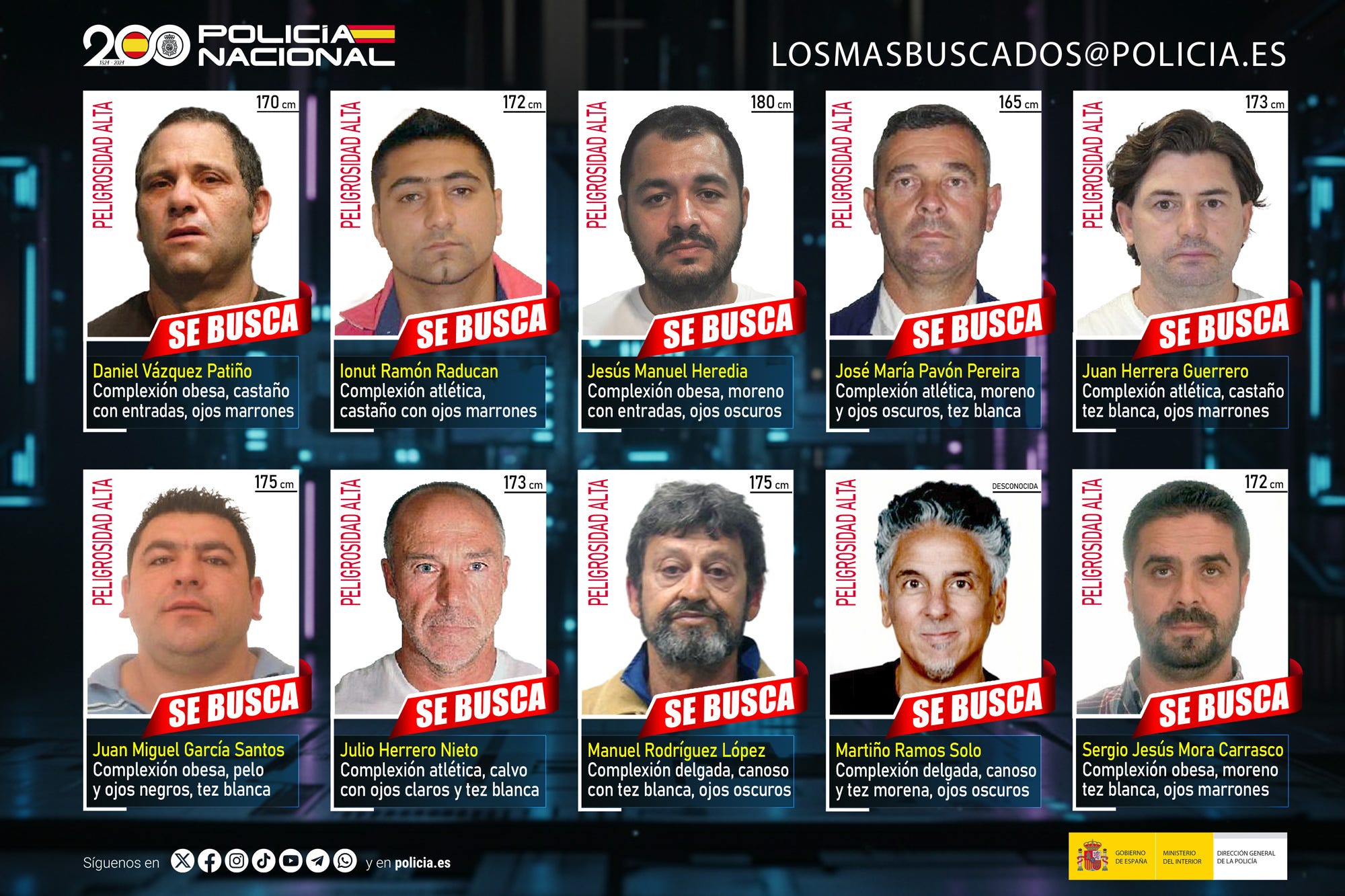
The Policía Nacional dropped its new Top 10 Most Wanted list this week. It’s the third such campaign in recent years, and if history is any guide, some of these fugitives won’t be fugitives for long.
Previous lists have worked. At least half of the fugitives listed on the Interior Ministry’s 2002 and 2024 versions were arrested, and police say citizen tips remain one of their most effective tools. Think America’s old “Most Wanted” posters at the post office, but updated with AI-aged photos and an email inbox for tips: losmasbuscados@policia.es.
So who made the list this year? In short, four narcos, three child-sex offenders, two violent criminals, and one murderer — all men, all labelled altamente o muy peligroso.
The mix says a lot about Spain’s crime landscape. There’s a heavy dose of drug trafficking (Galicia and Huelva make strong showings), depressingly persistent child abuse cases, and the occasional killer or serial robber woven in for variety.
Among the standouts are the three fugitives with nicknames — always a sign you’ve achieved a certain criminal, um, notoriety.
Jesús Manuel Heredia Heredia, “El Pantoja”. A 40-year-old narco from Algeciras and heir to the Los Pantoja clan, Pantoja is considered one of Spain’s most prolific traffickers. Protégé of Abdellah El Haj, aka “El Messi del hachís,” he moves drugs through the Campo de Gibraltar like other people move groceries. He even managed to flee prison during a penitentiary leave in 2025 — a very on-brand detail for someone with a whole clan behind him.
Ionut Ramón Raducan, “Florin”. A Romanian trafficker from a family long linked to street prostitution in Madrid’s Polígono Industrial Marconi. Florin was convicted of human trafficking for the purposes of sexual and labor exploitation in 2014, for forcing both his underage sister and his partner into prostitution, whom he beat if she didn’t bring in enough cash. The police want him back.
Sergio Jesús Mora Carrasco, “Yeyo”. One of Europe’s heavyweight hashish traffickers, accused of moving literal tons of product via fast boats. Known for his large-scale maritime operations, Yeyo supplied much of Europe in the 2000s and built a fleet that would make Walmart’s logistics chief blush.
Oh, and one more we should mention (but no nickname). Who?
Martiño Ramos Soto. A former Ourense music teacher who sexually abused a student for years. He fled in July after his conviction — but with a twist: hours after the list went public Monday, Cuban authorities arrested him in Havana, where he’d been working as a photographer under a slightly tweaked name. Spain has already requested extradition.
So the list is barely 24 hours old, and it’s already paying off… or the police just gave themselves an easy win. Either way: nine to go.
4.🔎 Why Ibiza’s ‘shaman death’ case is being investigated again

One of Ibiza’s strangest and most unsettling cases is back in the headlines. A judge has decided to reopen the investigation into the 2024 death in Ibiza of Flor Bollini — the Argentina-born Italian known globally as the “shaman to high-performing executives.”
Not so accidental after all. Bollini’s death, discovered during an all-night party at the villa of a Swedish millionaire, was initially ruled an accident. A year later, the case has come roaring back with accusations of homicide, drug crimes, and even theft. Classic Ibiza: nothing is ever just what it looks like.
Who she was. Bollini wasn’t a random plus-one. At 44, she was a star in the psychedelic-therapy world — crowned by Forbes as the “Corporate Shaman.”
She founded NANA Health, a women-run psychedelic platform that raised over $1 million, and guided wealthy clients through ayahuasca, ketamine, and the ultra-potent Bufo toad secretion.
Her life moved between Miami, California, and Ibiza — the Bermuda Triangle where money, mysticism, and microdosing meet.
The party. In October 2024, she attended what was advertised as a “kitchen party” at a luxury villa. The WhatsApp invite told guests to bring “whatever they felt like,” punctuated with emojis of pills, cocktails, snow, horses, and stacks of cash: 💊🍸❄️🐴💶. (iykyk)
The turn. The gathering — described by attendees as a “wild pajama party” — had been rolling for more than 24 hours when things went wrong.
The hot spot. The villa also featured a wood-burning sauna by the pool, marketed in the invite as a place to “disconnect from whatever is happening and start again.” It was there, guests say, that Bollini spent much of the night.
The surreal tableau. At some point she died — and was found naked and burned inside the sauna. Guests moved her body to a poolside table, lit candles around her, and waited for authorities. Several told police she’d been performing Bufo rituals and had heart problems. Toxicology results did not agree.
What the tests showed. There was almost no alcohol in her system. Drugs were present, but not in lethal amounts. There was zero trace of Bufo. Despite the contradictions, the case was closed as an accident.
Now the family is pushing back. Their lawyer has convinced a judge to reopen the investigation, arguing there are clear signs of homicide or, at a minimum, gross negligence — along with drug offenses and missing personal items.
The suspects. He wants the homeowner and six other guests placed under formal investigation. A crucial piece of evidence may be Bollini’s smart ring, which logged her heart rate and body temperature in the hours before she died. 🤔
Ibiza has questions. What really happened in that sauna? Why was her body moved? And did anyone at that villa help cause — or cover up — her death? The island’s most mystifying case is suddenly wide open again.
5. ✈ Maduro has survived Trump’s threats (so far). Your vacation has not
“The first casualty of war is truth,” an isolationist U.S. senator said during World War I — but honestly, the first casualty this week was your Caribbean getaway. At least if it involved a quick hop from Madrid to Caracas.
What happened? The U.S. Federal Aviation Administration (FAA) issued a sharp warning on Friday telling airlines to “exercise caution“ when flying over Venezuelan airspace because unspecified threats “could pose a potential risk to aircraft at all altitudes.”
Why? Because Donald Trump has parked the world’s biggest aircraft carrier — the USS Gerald Ford — off the Venezuelan coast as part of his new so-called anti-narcotics mega-operation, “Southern Spear” U.S. officials told Reuters that the next phase could start any day now — insert 😱 here — possibly involving covert missions. Also on the menu of possibilities: knocking Venezuelan President Nicolás Maduro out of power.
The FAA didn’t technically ban flights. It just said: massive military buildup, radar interference, possible missile systems online… so, you know, maybe don’t fly there for a bit because, like, it would be terrible if something happened to your nice plane.
Airlines took the hint. Iberia grounded all flights. Air Europa followed. Plus Ultra hit pause. TAP, Gol, Latam, Avianca, Turkish Airlines — all said “vuelos cancelados.”
Within 48 hours, Madrid-Caracas went from 36 weekly flights to zero. Spain’s AESA echoed the U.S. warning and advised airlines to avoid Venezuelan airspace until at least Dec. 1. The Spanish government also reminded everyone that traveling to Venezuela is not recommended unless strictly necessary, which is diplomat-speak for: don’t expect us to help you.
Maduro’s revenge. Caracas was furious. The civil aviation authority, INAC, issued an ultimatum: airlines had 48 hours to restart service or lose their “permanent flight licenses.”
Tough talk, but… Timbers were shivered (well, maybe they were…), but when the deadline arrived at 5 p.m. Wednesday, nothing happened. No sanctions, no license revocations, not even a sternly worded Instagram post with an angry face emoji 😡 (Seriously, not even that, Nicolás?).
The flights remain suspended, the airlines remain spooked, and Venezuela can do nothing but yell into the Caribbean air.
Maduro has so far survived U.S. pressure, CIA rumors, and a giant aircraft carrier. But he’s less successful at dodging mass flight cancellations. Well, he can sympathize with Russia and North Korea, fellow members of the Axis of the Grounded. At least until Dec. 1, or his overthrow.
🙏 Once again, please remember to share this newsletter with your friends on social media. The more we grow, the more information we’ll be able to offer each week.
We’ll be back next week with more.