

🇲🇦 Ceuta After the Chaos
What we know and what we don't.
Madrid | Special Summer Issue | The Bubble is Spain's #1 English-language newsletter. We offer paid and free subscriptions (which you can customize). For sponsorships, click here.
72,000 crossings and 80 deaths
🔥 Ceuta after the chaos: what we know so far
Yes, last week we said this newsletter was taking August off. But then a massive crisis exploded at the Spain/Morocco border with tragic consequences. Here is a quick summary of what you should know.
You’ve probably seen the images by now. Tens of thousands of mostly young Moroccans swimming around breakwaters, climbing fences, and overwhelming the beaches of Ceuta sparked panic across Spain, alarmed European governments, and dominated headlines around the world.
Social media was on fire. Influencers and media outlets were covering it across the board, many of them portraying it as proof that Europe had lost control of its borders.
Now, almost a week later, the emergency phase appears to be over. But while the crowds have largely disappeared, many of the biggest questions remain unanswered.
What we know so far. The scale of this crisis was totally unprecedented. Around 72,000 people crossed into Ceuta in just a few days, making it by far the largest irregular border crossing Spain has ever experienced.
Before you panic. Around 70,000 have already been returned to Morocco, while others (many of them minors) are still in the area. The authorities are assessing their situation.
The human cost was high. Authorities are now working to identify 80 confirmed victims (an NGO says the total is 141, counting the ones who died on Moroccan soil), most of whom drowned while trying to reach the Ceuta shore. Many remain unidentified, and Spanish forensic teams continue coordinating with Moroccan authorities to notify families.
Viralization effect. Investigators now agree that the crisis was mainly caused by a coordinated social media misinformation campaign. Viral TikTok videos, Facebook groups, and WhatsApp messages all falsely claimed that “Spain’s border is open” and that migrants arriving by sea could no longer be returned after a recent Spanish Supreme Court ruling.
The posts even shared Google Maps routes, recommended where to buy wetsuits and waterproof bags, and pointed people toward the least guarded sections of Ceuta’s coastline before disappearing from the internet.
Europe’s initial reaction. In the first 48 hours, several European governments reacted with concern. Italy reinstated temporary passport checks for travelers arriving from Spain, while politicians in Finland and Denmark and elsewhere questioned whether Spain’s handling of the crisis threatened the Schengen Area and suggested that Spain's recent regularization drive may have acted as a "pull” factor for the immigrant flood. Twenty-two EU countries called for emergency talks over the crisis.
That tone has now changed. Following that emergency meeting of EU interior ministers on Tuesday, member states largely rallied behind Spain, praising its response and expressing “total solidarity” with Madrid.
The focus has shifted from criticizing Spanish migration policy to strengthening the EU’s external borders, improving intelligence sharing, and dismantling migrant smuggling networks.
Italy remains the exception. Rome has kept temporary passport checks in place, although it is increasingly difficult to defend doing so, given that Ceuta is not part of the Schengen Area and nearly all of those who entered have already been returned to Morocco. (And Italy has more irregular migrant crossings than Spain.)
Was this a “manufactured” crisis? So far, we’re not sure. Officially, Morocco insists it neither encouraged nor organized the mass crossing. But Morocco has repeatedly outmaneuvered Spain politically in recent years, using immigration as a weapon.
Rabat claims the trigger was Spain’s Supreme Court ruling. Moroccan officials also say that decision spread rapidly across social media, convincing thousands of young people that reaching Ceuta meant reaching Europe.
Morocco also says its police avoided confronting such enormous crowds to prevent even greater loss of life, and emphasized that it continues accepting the return of migrants under existing agreements. Moroccan authorities have now prosecuted 77 people accused of organizing illegal crossings or participating in violence during the crisis.
We beg to differ(ish). Spanish intelligence, however, paints a more nuanced picture. Their current assessment is that Morocco did not plan the operation, but allowed it to happen and then exploited it politically once events spiraled out of control. That distinction may prove important as relations between Madrid and Rabat enter another delicate phase.
It comes at a particularly sensitive moment geopolitically. Morocco has grown noticeably closer to the Trump administration in recent months, while relations between Pedro Sánchez and Washington remain strained over defense spending and foreign policy.
Morocco also continues to press its long-standing claims over Ceuta and Melilla whenever opportunities arise (FYI: Ceuta and Melilla are not colonies but Spanish exclaves on African territory. Their citizens are Spanish with full rights. Ceuta has been a part of Spain since 1580.) Things are so tough that leftist coalition Sumar is saying Spain shouldn’t even organize the 2030 World Cup with Morocco.
Enter the far-right. While the border itself has largely returned to normal, the political battle is only beginning. Across Europe and the U.S., far-right politicians quickly framed the events as proof of an “invasion.” U.S. Vice President JD Vance, Britain’s Nigel Farage, Germany’s Alice Weidel, and others shared videos suggesting these migrants were now heading across Europe.
Obviously, this isn’t true. Ceuta is not mainland Spain and, as we explained above, entering Ceuta does not provide automatic access to the Schengen Area. Everyone leaving the city for mainland Spain must pass through identity checks at the port or airport. Plus, most of them were sent back to Morocco, so… no.
Other fake news spread just as quickly. Claims that Sánchez’s recent migrant regularization encouraged people to cross the border “so they could become citizens and vote for him” ignore the basic fact that the people who arrived in Ceuta would not qualify under that program (in order to qualify, you had to be living in Spain and the deadline to apply has passed).
This was a big f*ck up, though. Even if Morocco bears significant responsibility or even instigated the crisis, Madrid is unlikely to escape scrutiny. The biggest question remains why Spanish intelligence failed to anticipate a movement that had been openly growing across Moroccan social media for days.
Interior Minister Fernando Grande-Marlaska insists the government received no intelligence warning suggesting anything close to a mass crossing of this magnitude. At the same time, he said stuff “happens” and that doesn’t necessarily mean someone is responsible. 🤔
That claim has triggered an unusual public disagreement within the government itself. Defense Minister Margarita Robles has defended the work of the CNI intelligence service while pointing out that Interior also oversees its own information services through the National Police and Civil Guard.
The opposition Popular Party has seized on the confusion, accusing Sánchez of leaving Ceuta unprotected despite warning signs. Party leaders argue the government failed to reinforce the border in time and are demanding a full parliamentary explanation.
And now? The immediate emergency may be mostly over, but few believe the story is finished. Authorities still do not know who created the original viral campaign that convinced thousands of people to head toward Ceuta. Most of the accounts disappeared almost immediately after the crisis began.
Spanish investigators are already monitoring new conversations circulating on Facebook and WhatsApp discussing another possible attempt on Aug. 15. Whether those calls represent genuine planning, copycat rumors, or another misinformation campaign remains unclear.
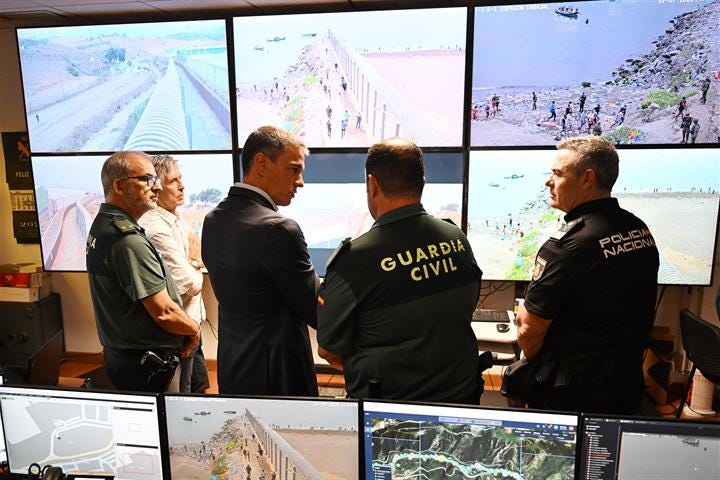
Spain has reinforced Ceuta’s maritime border with floating barriers, patrol boats, and extra security in an effort to prevent another mass crossing.
What is clear is that this has become a test of border security, intelligence gathering, information warfare, and Spain’s relationship with Morocco. The crossings may have mostly stopped (or at least paused), but the political blowback is only beginning.
🎙️ Episode 4 of The Bubble Podcast is out!
On our latest episode, we discuss what it really means to belong in Spain today and explore one of the country's biggest identity debates—from immigration and Spain's record-breaking migrant regularization to the controversial Ley de Nietos—alongside Sweden's ambassador to Spain and writer Elizabeth Duval.
Subscribe and listen on Spotify, Apple Podcasts, and YouTube!
🔔 Don’t forget to follow us on TikTok!

If you’re not following us on TikTok yet, you’re missing out. We’re posting exclusive content with our collaborators across Spain, breaking news updates, and pop culture coverage. Click on the post above and come hang with us!
🙏 Once again, please remember to share this newsletter with your friends on social media. The more we grow, the more information we’ll be able to offer each week.