



Madrid | Issue #137
🇪🇸 The Bubble is Spain's #1 English-language, best-selling newsletter. We offer paid subscriptions, and we’d be thrilled to have your support!
🚨 Customize your subscription! You can personalize your Bubble experience so you only get the emails you want—and never the ones you don’t. Click here to learn how.
📺 Sponsorship opportunities. Want to get your brand in front of our engaged and influential audience of professionals, creatives, and government workers? We’re now offering a variety of ways to do so. Click here to find out how and book a spot.
Fashion police
🧕 Europe's burqa (and niqab) ban wave comes to Spain
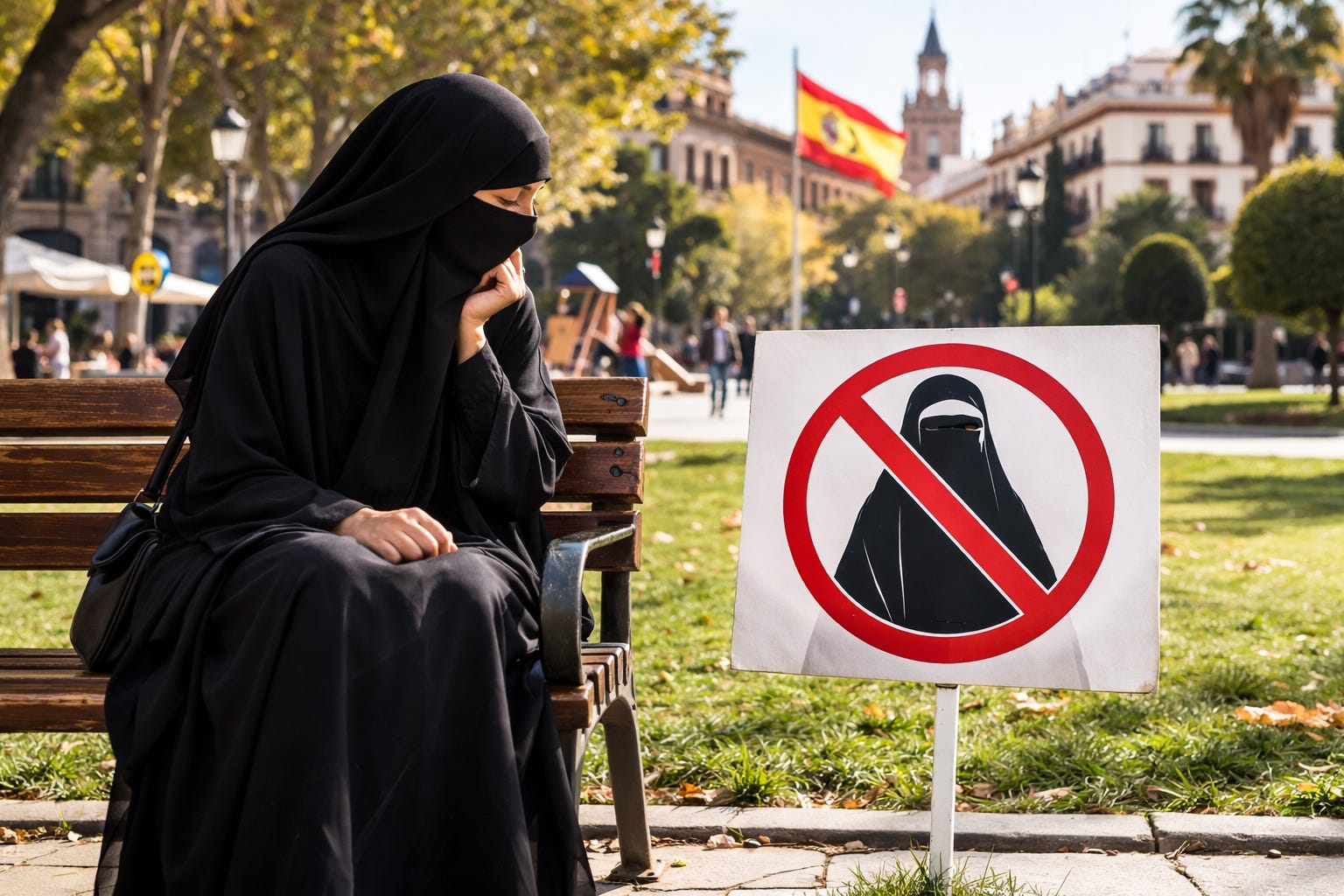
The fight over the burqa and niqab just landed in Spain with a big ‘thud’. Arguments over the garments worn by some Muslim women that (respectively) cover the entire face or all but the eyes have been raging across Europe for years, but Spain’s current political weather meant that, well, right now was the time for it to burst on the scene, wet, confused, and screaming like a newborn child.
The trigger? Yup, it was the far-righties of Vox, who brought a law to Parliament this week framed as “protecting women’s dignity” and “citizen security,” with a preface that warns darkly about “mass immigration” from countries with “strong Islamist influence” and the supposed “normalization” of people “circulating with their face covered.”
What’s actually in it? Well, a lot. Vox’s text pushes (1) fines for wearing the niqab/burqa in public spaces—starting around €600 and escalating (with repeat offenses) up to €30,000 — (2) prison sentences for anyone who “imposes” the garment through coercion (Vox proposes up to three years, higher if the victim is a minor or otherwise vulnerable), and (3) changes that would make it easier to expel foreign nationals for certain “very serious” infractions.
Why did the PP back it? And not just kinda, but enthusiastically. Because the PP is in the awkward position of needing Vox as a coalition partner in two regions (Extremadura and Aragón) — and, more broadly, needs to keep the coalition math viable ahead of Castilla y León’s March 15 regional election. The burqa vote is something the right can agree on without having to talk about things like climate policy, Europe, or whatever else Vox is currently trying to set on fire.
The standard reasoning behind a ban comes in two flavors. One is security and identification: a state can’t identify you if it can’t see your face. The other is women’s equality. As in, the full-face veil is cast as a symbol of coercion and erasure, especially when worn under pressure from family or community. Vox leans hard on both, but peppers it with civilizational language that makes it clear that they’re not, like, super “Pro-Muslim.”
That cultural squirreliness is a basic reason why everyone else voted it down. The outcome: Vox and the PP (and one small ally) were outnumbered; the proposal was rejected 177–170, with one abstention.
The PSOE position was basically, “Nice try, but no.” Socialists argued the Vox text collides with constitutional protections — particularly religious freedom and non-discrimination — and, in any case, is transparently designed to “feed” a xenophobic narrative rather than solve a real problem (the number of women wearing niqab/burqa in Spain is pretty small).
The right-wing Catalan separatists of Junts, meanwhile, rejected Vox with its usual left-right punch. That is, no to the burqa bill… but even more no to Vox. They insisted they will “never” support Vox because it’s “anti-Catalan” and, well, politically radioactive.
But, but, but… It’s not that black-and-white. Because, you see, every party has reasons to entertain a ban, from public pressure to political competitors.
Junts actually introduced its own ban bill. Their text prohibits the use of garments that “totally or substantially” cover in public spaces, with some exceptions. So what’s the difference? For one thing, their bill delegates the powers over the “security and identification of persons” to the regional government so it can police its own immigration (separatists 🤷). Plus, Junts is fighting its own Islamophobic-adjacent competition on the right — Aliança Catalana.
Even inside the PSOE world, you could hear the faint sound of gears turning. Barcelona mayor Jaume Collboni said the burqa should be “regulated” and called it a denial of women’s identity — while warning that a flat ban could backfire if it effectively pushes women out of public space.
In fact, just after voting down Vox’s proposal and saying it “stems from racism and the criminalization of those who are different,” PSOE congressional spokesman Patxi López praised Junts’ proposal because “it hasn’t adopted the far-right’s framework,” and said the socialists would “study” the initiative and “open that debate.”
That brings us to the awkward ending. Some kind of restriction feels inevitable. Not necessarily Vox’s culture-war version — but something. Immigration anxiety (justified or not) has been turbocharged in Spain lately, and it spiked further after the government launched its extraordinary regularization process for people who can prove residence before Dec. 31, 2025 (applications April–June 2026). The right has promoted a cinematic narrative about floods of immigrants waiting outside the Moroccan and Pakistani consulates, sometimes faking documents.
Crucially, Spain isn’t inventing this debate. Across Europe, bans or partial bans on full-face coverings already exist — France led in 2010, followed (in various forms) by Belgium, Austria, Denmark, the Netherlands, Germany, Bulgaria, Portugal, and others.
Spain joining the list seems largely a matter of time.
More news below. 👇👇
🔔 Don’t forget to follow us on Instagram!
If you’re not following us on Instagram yet, you’re missing out. We’re posting exclusive content with our collaborators across Spain, breaking news updates, and pop culture coverage. Click on the post above and come hang with us!
💬 Five things to discuss at dinner parties
1. 🔴 Spain’s left scrambles to unite as Vox keeps rising
Extreme Mild Makeover. Spain’s non-PSOE left is making its latest attempt to join forces and avoid irrelevance as the right — especially the far-right — climbs in the polls. The recent drubbing in Aragón — where the PSOE plunged, the PP stagnated, and Vox surged from 11% to 18%, doubling its seats — was a wake-up call.
The read for leftists is brutal. The mainstream right is treading water, the radical right has momentum, the PSOE fell off a cliff, and the further left looks fragmented and tired.
Wake-up call. Last week, Gabriel Rufián, MP from the leftist Catalan separatist ERC, gave one of his bluntest warnings yet: “Either we talk to each other, or we’re f*cked” (see video above).
Rufián — articulate, permanently online, and fond of trolling everyone — argued that forces to the left of the PSOE can’t afford turf wars. What’s coming, he warned, isn’t politics as usual but a European version of the authoritarian drift seen in the U.S.
A new name to learn. A group of leftist parties is now launching an alliance under the slogan Un paso al frente (“A step forward”). Izquierda Unida, Más Madrid, Comunes and Movimiento Sumar are backing it.
Their goal is to rebuild a broad progressive front before the next general election and stop Vox.
But this also reflects panic. They know they are losing ground not just electorally, but emotionally. Fewer people feel excited by them, and the right currently monopolizes the energy.
Consider Second Deputy Prime Minister Yolanda Díaz. Founder of the Sumar coalition (vaguely left in a marshmallow blobish way), she remains the best-known figure to the left of the PSOE. But she’s the junior partner in an unpopular socialist government, and increasingly questioned after poor results and falling popularity.
Organizing is proving messy, however. A big launch event in Madrid this Saturday is meant to show unity. But Díaz herself won’t attend, fueling speculation about whether she even wants to lead again.
Far-left Podemos is staying away too, nationalist/separatist parties aren’t joining the photo, and even inside Sumar there’s confusion about what comes next: A new name? A new brand? The party has an unclear program, and no obvious successor to Díaz.
Meanwhile, Rufián’s separate public talk yesterday with Más Madrid’s Emilio Delgado generated media buzz — but without any formal party backing it, it looks more like a symptom of the vacuum than a concrete strategy.
Looming over all of this is the brutal reality of the polls. The left knows it’s not doing well: voters are unmotivated, leaders have burned through political capital quickly, and Vox is thriving on rural and economic discontent and cultural resentment.
Stay away, Pedro. Many (if not most) on the left also don’t want this reorganization tied to PM Pedro Sánchez. A recent El Español poll suggests that his unpopularity could drag the broader left-wing bloc toward its worst result in decades.
The state-run CIS offers the PSOE a more optimistic picture. But then again, the CIS is run by a former member of the PSOE executive committee whose rosy poll numbers for his party have been wrong so often that they mostly qualify as wish fulfillment.
2. 💣 Police no. 2 resigns after bombshell rape accusation
Hard to keep up. Oh, look. Another explosive scandal hits Spain, this time landing right at the top of the National Police. José Ángel González Jiménez, the Director Adjunto Operativo or DAO, of the Policía Nacional, resigned on Tuesday after a Madrid judge admitted a criminal complaint accusing him of rape. González has been summoned to testify on March 17 and is formally under investigation as a suspect.
González was no mid-level official. He was the highest-ranking operational commander in the National Police, appointed in 2018 by Interior Minister Fernando Grande-Marlaska, and widely seen as one of his most trusted men. His sudden fall has triggered shock inside the force — and yet another headache for the government.
What happened. The complaint was filed by a female police officer who dated González for a while and who says she was assaulted by him in April 2025, while she was on duty.
When the boss is an ex-boyfriend. According to her lawyer, she received repeated calls ordering her to leave her post, pick González up in an unmarked official vehicle, and drive him to his official residence.
Asymmetrical relationship. She says she was pressured to enter the house, where he assaulted her sexually, including penetration with his fingers (despite her verbal refusals). The complaint says González used the authority of his position to intimidate her and overpower her.
She also claims that afterwards she faced months of pressure to keep silent, and even an attempt to “buy” her silence through professional favors in exchange for not reporting what happened. She is currently on psychological leave.
González has denied wrongdoing and insists he stepped down voluntarily as soon as he learned of the complaint. The government, meanwhile, maintains that the Interior Ministry forced his departure once the court formally admitted the case.
The PP used the scandal as a political weapon. Party boss Alberto Núñez Feijóo yesterday accused the government of protecting González until the story became public; demanded Interior Minister Marlaska’s resignation; and questioned how Marlaska could plausibly claim ignorance about such a serious accusation involving his own police chief.
Marlaska, however, said he was “deceived” and “deeply disappointed,” insisting he knew nothing about the complaint until this week. He even said he would resign if the victim herself felt “he failed her”.
Even PM Sánchez got involved (while he was in India), calling the accusations “very serious” and insisting his government acted immediately with “forcefulness, coherence and empathy” once they learned of the case.
More bad news for PSOE. This is yet another brutal scandal in an area where public tolerance is thin. The PSOE and its orbit have faced multiple sexual misconduct controversies recently, and each new case reinforces a story of institutional decay and impunity.
3. 📈 Spain closes in on 50 million residents
Spain is approaching a big, round number: 50 million residents. According to the latest data from the Instituto Nacional de Estadística (INE), the country hit 49.57 million people on Jan. 1, a new record.
There was even a kind of Baby Boom. No, it’s not a 1960s comeback tour. But in 2025 Spain’s birth rate increased — according to INE — for the first time in over a decade. In 2025, 321,164 babies were born — 3,159 more than in 2024.
Just the facts. Overall, Spain added around 450,000 people in the last year, and almost all of that growth came from migration. In fact, for the Spanish-born population, natural change (births minus deaths) remains negative. So the Baby Boom was undone by a bigger Death Boom. Without immigration, Spain would be shrinking.
Here’s another big number. 50 million may seem like a major achievement, but the real milestone isn’t just the total. The most eye-catching fact is that for the first time, more than 10 million residents were born abroad (10,004,581, to be exact). That’s just over 1 in 5 people in Spain.
The young and the restless. Here’s where it gets even more interesting. In cities like Madrid and Barcelona, nearly half of residents aged 25–39 were born abroad, according to recent INE breakdowns. In some inland provinces, that figure is closer to 10%.
Let’s translate that. Spain’s big urban labor markets are being powered by people who weren’t born here. And they’re overwhelmingly of working age. Nationally, about 42% of foreign-born residents are between 30 and 49, and another big chunk are in their 20s.
Back-of-the-envelope math. Migration is helping Spain grow faster than much of the eurozone because it’s expanding the workforce. JPMorgan and the Bank of Spain have both noted that immigration has contributed meaningfully to recent GDP growth.
But, but, but… If Spain’s GDP grows around 2.5–3% and the population grows roughly 1%, then the GDP per capita rise is closer to 1.5–2%. That’s still solid. But it’s not “economic miracle” solid.
Which goes a long way toward explaining people’s frustrations. More workers means more people competing for the same resources, especially housing. You may have heard people complain about housing prices?
Enter politics. The right-wingers of Vox has denounced the social and economic impact of this recent achievement, stating that this “increases insecurity in neighborhoods, and terminally overloads essential public services”.
Here’s the paradox: Without immigration, Spain’s economy would likely be weaker and its population declining. With immigration, growth looks better, but competition for apartments in Lavapiés looks worse.
The verdict? You’re allowed to brag about the growth numbers. Just maybe don’t do it in front of someone paying €1,400 for a 45m2 flat.
4. 🖼️ The Canaries are going for baroque
This is an only-in-Spain story about art, taxes, and how politics can sometimes allow you — or force you — to pay your inheritance bill with a mythological kidnapping.
It begins with the Condado de la Vega Grande de Guadalupe, the bluest of Canary bloodlines, a title granted in 1777 — the year after the country that would later give us Pop Tarts, Fruit Loops, and Donald Trump declared independence.
For centuries, the family controlled vast swathes of Gran Canaria, pioneered tomatoes and tourism (hello, Maspalomas!), and generally behaved as if they owned the island. Which, at times, they basically did.
Fast forward to 2020. The ninth count dies. The inheritance clock starts ticking. And thanks to the left-leaning “Pacto de las Flores” government then in power, the Canary Islands had just scrapped the near-total 99.9% inheritance tax break for close relatives. Big fortunes would now pay actual money. Revolutionary stuff.
The family’s bill? It reportedly came in around €4m. 🫢
Liquidity, however, is not always the strong suit of old aristocracies. (Land? Yes. Titles? Totes. Weird intra-cousin marriages? Absolutely. Cash? Not so much.) So in 2021, the tenth count and his siblings reached a very Spanish solution with Hacienda: payment in paint.
Enter baroque drama. A dozen paintings — including two monumental canvases by Luca Giordano, plus works attributed to Bartolomé Esteban Murillo and Juan Carreño de Miranda — were handed over to the Canary government. Neptune flexing. Persephone being abducted. Seventeenth-century mythological chaos, now serving the Tax Agency.
Market estimates suggest the bundle could be worth somewhere between €3.5m and €5m. We imagine the appraisal meeting between the family and the tax man was lively.
The paintings are now public property. The two Giordanos — Neptuno and El rapto de Proserpina, each over three meters wide — are being restored in Madrid at state expense (humidity, fungi, wood-munching insects… even gods suffer).
They’re expected to hang in the future Museo de Bellas Artes de Gran Canaria in Vegueta when it opens (we hope) later this year. Which is poetic, given they once adorned the family dining room a few streets away.
It's all in the timing. In 2023, a new right-leaning Canary government restored the 99.9% inheritance tax break for close relatives. Under today’s rules, that €4m bill would likely have been reduced to something… decorative.
Yeah, irony. Had the count died a few years later, Neptune might still be looming over the soup course in Vegueta.
5.🪩 Benidorm Fest 2026 crowns Tony Grox & LUCYCALYS in the most controversial edition yet
Gays Music fans, rejoice! Benidorm Fest has crowned its new champions, and this year, the victory comes with a big asterisk.
Tony Grox & LUCYCALYS, a duo from Cádiz, won this year’s edition of the popular music festival with their song “T AMARÉ,” (see video above), finishing with 166 points thanks to overwhelming audience support.
Catchy tune. Their track is built around an irresistible contrast: flamenco emotion on one side and sleek electronic minimalism on the other, creating a fusion that feels both classic and modern.
Their presence on stage helped, too. A DJ table placed inside the fountain of an Andalusian patio (‼️), became instantly iconic.
Thank you for the music. Musically, the night was a clash between the jury’s taste and public passion (when is it not?). While the professional jury’s top choice was Asha, with her song “Turista”, the public vote belonged to Tony Grox & LUCYCALYS, who dominated the televote and ultimately took the title.
For the love of money music. The win comes with the festival’s signature trophy (the Sirenita de Oro, or Golden Mermaid) and a cash prize: €100,000 for the performers plus €50,000 for the songwriters, as well as a boost from Univisión, which will take the winners to the U.S. to record with a top Latin producer.
A big f*cking deal. The Benidorm Fest is Spain’s pop obsession. It’s also the national contest that chooses the country’s representative for Eurovision, aka the Gay World Cup.
Even if you don’t care about Eurovision, the Benidorm Fest has turned into something enormous that acts as a showcase of Spain’s music industry, its queer cultural energy, and its internet fandoms.
The final was the most-watched program of the day, reaching more than 4.1 million unique viewers, with especially huge figures among younger audiences.
The big asterisk. The 2026 edition hit different, though, because it was the first Benidorm Fest to be officially disconnected from Eurovision.
Remember? Spain, alongside several other countries, announced last year that it would not participate in Eurovision if Israel remained in the contest.
So while it was fun to watch, the controversy cast a shadow over the entire week as the usual “road to Eurovision” narrative was… absent.
🙏 Once again, please remember to share this newsletter with your friends on social media. The more we grow, the more information we’ll be able to offer each week.
